How to Find Guest Post Sites with Real Traffic and High DR Metrics

Guest posting only works when the site can do two things at once: pass real authority and put your content in front of actual readers.
A lot of link builders chase one metric and ignore the other. They buy placements on high-DR sites with dead traffic, or they publish on sites with decent traffic but weak link equity and no topical fit. Both mistakes waste budget.
If you want placements that still look good six months from now, you need a repeatable process for finding sites, filtering them fast, and pitching the ones worth your time. This is the foundation for anyone looking to get guest posts on high DR websites that actually move the needle. That is what this guide covers.
TL;DR
- The "Zombie Site" Filter: Never trust DR alone. A high-DR site with zero organic traffic is a major red flag for rented authority or a decaying domain. Always verify 12-month traffic stability.
- Traffic-to-Backlink Ratio: A healthy site's traffic should scale proportionally with its authority. If a DR 70 site has only 100 monthly visits, it lacks real trust from Google's algorithms.
- Keyword Intent Analysis: Check if a site's traffic comes from "junk" keywords (e.g., "calendar 2026") or relevant niche terms. Use Rankchase's Free Website Analyzer to automate this via the Niche Quality Score.
- Scale Your Outreach: Join Rankchase to access a pre-vetted database of guest post opportunities, ensuring every partner meets strict DR and organic traffic requirements.
- Relevance > Authority: A DR 35 niche-specific blog with steady search traffic is often more valuable than a DR 70 general site with weak topical alignment.
- Editorial Integrity: Only pitch sites with named authors, original data/screenshots, and selective outbound links. If a site links to everyone, its link equity is diluted.
Why Both Traffic and Domain Rating (DR) Matter for Guest Posting
DR tells you something useful, but only one thing. It tells you the relative strength of a domain’s backlink profile according to Ahrefs. Ahrefs is explicit that DR is a proprietary, relative metric, not a Google ranking factor. That matters because people still treat DR like a final verdict when it is really a screening signal.
Traffic adds the missing layer. If a site ranks for real keywords, pulls in organic visitors, and has pages that actually get indexed and updated, you are much less likely to be dealing with a polished shell site built only to sell links.
Here is the practical way to think about it:
If I had to choose between a DR 70 site with no visible search presence and a DR 38 site with stable organic traffic in my niche, I would usually take the second one. The first often turns out to be a site living off old links, rented authority, or a decaying domain.
That does not mean traffic always beats DR. It means you need both in the conversation.
A simple decision rule works well here:
- High DR + real organic traffic + niche relevance = strong target
- High DR + no traffic = investigate hard. This is often a sign of a "zombie site" that has authority on paper but no trust from Google's ranking algorithms.
- Traffic + very low DR = possible brand play, weak authority play
- Good metrics + off-topic niche = usually skip
Google’s guidance also supports a quality-first approach. Google warns against large-scale guest posting and article campaigns done mainly to build links, and it recommends focusing on helpful, people-first content rather than search-first publishing. Excessive sponsored and guest-post links without proper qualification can also trigger link spam evaluations.
So the target is not “any site with DR 50+.” The target is a credible site where your article could reasonably exist even if SEO did not exist.
How to Evaluate and Identify Quality Guest Blogging Opportunities
Once you have a list of prospects, the real work starts. This is where most campaigns win or lose money.
Verifying Genuine Organic Traffic
Do not stop at the headline traffic number. You want to know if the traffic is real, relevant, and still holding.
Start with three checks:
-
Check trend direction
If traffic fell off a cliff in the last 6 to 12 months, pause. A site with a DR badge and a collapsing search footprint is often a bad long-term bet. -
Check where the traffic lands
If most traffic goes to irrelevant pages like random calculators, coupon pages, or AI-written glossary content, your guest post will likely live in a weak section of the site. -
Check branded vs non-branded visibility
A healthy site usually ranks for a mix of topic terms, not just its own name.
A fast workflow looks like this:
- Open the domain in your SEO tool
- Review organic traffic trend over 12 months
- Check top pages
- Scan top keywords
Using the Bulk Domain Checker for Fast Vetting
To speed up this process, you can use our Bulk Domain Checker, which allows you to analyze multiple domains at once. It provides instant data on DR, organic traffic, and spam scores. Most importantly, it includes a Niche Quality Score that automatically verifies if a site's top-performing pages actually match its stated niche, helping you avoid sites with "junk" traffic.
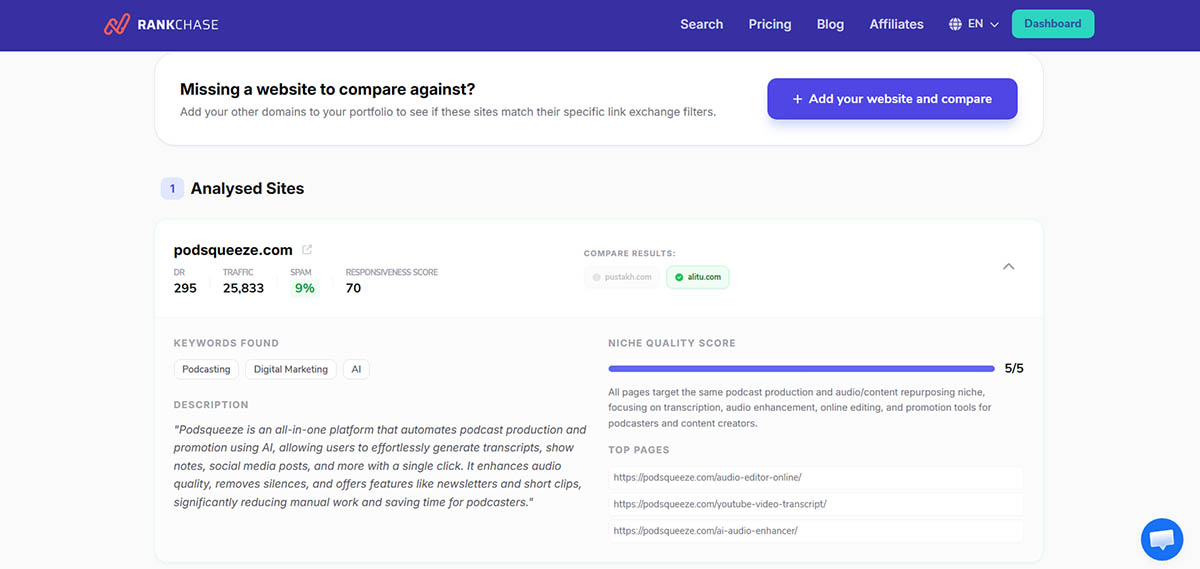
- Calculate the Traffic-to-Backlink Ratio. If a site has a DR of 70 but only 100 monthly visits, it’s a major red flag. A healthy site should have traffic that scales somewhat proportionally with its authority.
- Analyze Keyword Intent. Check if the traffic comes from commercial keywords related to the niche or "junk" keywords (e.g., "convert youtube to mp3" or "calendar 2026") that bring volume but zero relevance to your business.
- Ask, “Would a person actually discover this site through search for topics in this niche?”
If the top pages are all unrelated to the niche the site claims to serve, that is a bad sign. A “marketing blog” getting most of its traffic from pages about celebrity net worth or random troubleshooting queries is usually monetizing expired authority, not building a real publication.
One more check that experienced link builders use: compare the site’s estimated traffic to visible freshness. If a site claims strong search visibility but the blog is stale, author bios are thin, and recent posts get no comments, shares, or updates, something is off.
Assessing Domain Rating (DR) and Authority
DR is useful when you treat it as a filter, not a finish line.
I like to bucket prospects this way:
- DR 20 to 39: can work well in narrow niches if traffic and relevance are strong
- DR 40 to 59: solid mid-tier range for many SaaS, agency, and B2B campaigns
- DR 60+: premium territory, but only if the site still has editorial integrity
Then look past the number.
Check:
- Referring domains trend
- Ratio of homepage links to deep links
- Whether links look editorial or obviously purchased
- Whether the domain has a natural link profile from relevant sites
Ahrefs notes that DR is relative by design, so moving from DR 70 to 71 is much harder than moving from DR 20 to 21. That is another reason not to obsess over narrow thresholds. A DR 47 site can be a better placement than a DR 61 site if the first is healthier and more relevant.
If you use other tools, remember their authority metrics are also proprietary. Semrush describes Authority Score as a compound metric for overall website quality, not a Google metric. Use these tools to compare options, not to pretend they are direct ranking formulas.
Checking Niche Relevance and Audience Engagement
This is the part weak link builders skip, and it is often the part that separates a safe, useful placement from a forgettable one.
Ask four blunt questions:
- Does this site publish for the same audience you want to reach?
- Would your article feel normal on this site?
- Are the existing posts in your topic area reasonably deep?
- Do readers show any signs of engagement?
Engagement does not have to mean a busy comment section. In many B2B niches, comments are dead everywhere. Better signals are:
- Posts are updated
- Authors are consistent
- Articles have thoughtful internal linking
- The site has an active newsletter or social presence
- Category pages show a clear editorial focus
If you sell accounting software, a finance operations blog is relevant. A general lifestyle site with a “business” category probably is not, even if the metrics look prettier.
This is also where a platform like Rankchase can fit naturally into the workflow. If you are trying to source partners at scale, filtering first by niche relevance, DR, traffic patterns, and spam indicators saves a lot of manual review time. The point is not to automate judgment away. The point is to narrow the list to sites that are more likely to make editorial sense.
Ensuring Strong E-E-A-T and Editorial Standards
You do not need to perform a formal quality audit, but you do need to check whether the site looks like a real publication.
Google’s people-first content guidance and its explanation of E-E-A-T make this practical. Trust is the central piece, while experience, expertise, and authority help support it. Clear authorship, evidence of who created the content, and transparency around how content is made all strengthen quality signals.
For guest post vetting, that translates into visible checks:
- Named authors with real bios
- About page that explains the publication
- Editorial consistency
- Articles with original examples, screenshots, or data
- Limited grammar issues and no templated filler intros
- Reasonable external linking, not a page stuffed with commercial anchors
A quick pass/fail rule helps:
If the site looks like it was built to publish articles rather than to serve readers, do not talk yourself into it because the DR is high.
Red Flags to Avoid: Spotting Spam Sites and Link Farms
Good opportunities rarely need detective work to prove they are real. Bad opportunities often do.
High Outbound Link (OBL) Ratios
One of the oldest link farm tells is excessive outbound linking.
You do not need a perfect OBL formula. Just inspect recent posts and ask:
- How many external links are in each article?
- Are they pointing to random industries?
- Do commercial anchors appear unnaturally often?
- Does every post have a guest author and two exact-match links?
If a site publishes “Top CRM Tips,” “Best Crypto Wallets,” “Home Remodeling Trends,” and “Legal Injury Advice” in the same week, all with money anchors to unrelated sites, that is not editorial breadth. That is inventory.
A practical threshold: if several recent posts each contain multiple commercial outbound links to unrelated domains, I usually cut the site immediately.
Sudden Traffic Drops and Toxic Domain History
A clean-looking site can still be a bad target if it has already been hit.
Look for:
- Sharp organic traffic declines
- Pages disappearing from index coverage
- A suspicious content reset after a domain ownership change
- Historic topics that do not match the current niche
- Old backlinks from foreign spam, hacked pages, or sitewide junk
If you can access the site owner’s Search Console during due diligence, the best confirmation is whether the domain has manual actions or security issues. Google says the Manual Actions report shows whether some or all of a site may not be shown in search results because of a manual action, and the Security Issues report flags hacked or harmful content.
Most of the time you will not get that access, so use indirect checks:
- Compare traffic over 12 to 24 months
- Review the Wayback history
- Check whether the indexed pages match the current brand
- Look for signs of a repurposed expired domain
A repurposed domain is not automatically bad. But if the old site was about local tourism and the new site suddenly sells guest posts in SaaS, finance, health, and casinos, walk away.
Low-Effort, AI-Generated, or Scraped Content
Google’s guidance does not ban AI because it is AI. The issue is low-quality content created primarily to manipulate rankings. Google specifically warns against extensive automation and content that mainly summarizes what others say without adding value.
For guest post prospecting, the question is simple: does this site publish useful original material, or bulk text that exists to host links?
You can usually tell fast.
Common patterns:
- Generic intros that say nothing
- No first-hand examples
- Repetitive sentence rhythm across dozens of articles
- Strange factual errors
- Articles that answer broad terms but never go deep
- Topic clusters that clearly chase search volume outside the site’s expertise
If the content feels assembled, your guest post will sit in a weak neighborhood. Even if the link gets indexed, it is the wrong kind of footprint.
Finding Guest Post Sites Using Advanced Google Search
Once you know what a good target looks like, Google search becomes much more useful. Not because it gives you a perfect list, but because it surfaces sites that openly signal editorial openness.
Top Search Operators to Discover Accepting Blogs
You do not need fifty operators. You need a small set that consistently finds pages worth reviewing.
Use combinations like these:
"your niche" "write for us"
"your niche" "guest post"
"your niche" "contribute"
"your niche" "become a contributor"
intitle:"write for us" "your niche"
intitle:"guest post" "your niche"
site:.com "your niche" "submit an article"
"your niche" inurl:guest-post
Google’s search help confirms practical refinements like using quotes for exact phrases, site: to limit results to a site or domain, and the minus sign to exclude unwanted results.
That means you can tighten noisy searches fast:
"write for us" "email marketing" -jobs -course -webinar
intitle:"guest post" SaaS -site:pinterest.com
"submit an article" fintech -sponsored -advertise
I also like footprint searches for editorial pages that do not explicitly say “write for us”:
"your niche" "contributor guidelines"
"your niche" "editorial guidelines"
"your niche" "become an author"
These often uncover better publications than the obvious guest-post pages, because stronger sites sometimes hide contribution options behind contributor or editorial pages.
Filtering Search Results for High-Value Targets
The search query is only the first half. The second half is filtering.
When a result appears promising, do this in order:
- Open the site
- Scan the blog and category structure
- Check whether the site still publishes consistently
- Validate traffic and DR in your SEO tool
- Inspect recent outbound links
- Decide whether the site belongs in your outreach list
This keeps you from wasting time gathering big spreadsheets full of junk.
A short checklist helps here:
- Topical fit is obvious within 10 seconds
- Recent articles look edited and readable
- Organic traffic trend is stable or improving
- DR/authority is strong enough for your campaign
- Outbound links look selective, not transactional
- Contact path exists and feels legitimate
If a result passes four or five of those checks, keep it. If it fails the first two, do not let the metrics rescue it.
Reverse-Engineering Competitors to Uncover Placement Opportunities
This is still one of the fastest ways to find sites that actually say yes.
The logic is simple. If a competing site has already earned or placed guest-post-style links on relevant domains, those domains are much more likely to consider similar contributions from you.
The process I use looks like this:
First, export backlinks for two to five real competitors. Do not choose giant publishers if you are a smaller brand. Choose businesses that operate at your level and actively invest in content.
Then filter for likely placements:
- Links to blog posts or author pages
- Anchors tied to branded or mixed-intent mentions
- Referring pages with contributor bylines
- Links from articles that look externally contributed
Now manually review the referring pages.
You are trying to sort links into buckets:
- Natural editorial mentions
- Guest posts
- Link insertions
- Partner mentions
- Resource page links
The gold is not just the domain. It is the pattern.
Example: if three competitors all appear on niche B2B publications that accept expert contributions, that is a strong signal that the publication is open to outside contributors and that the audience is commercially relevant.
A good operator to pair with this is a branded Google search:
"competitor brand" "guest post"
"competitor author name" "contributor"
"competitor brand" site:targetdomain.com
This often exposes author profiles, contributor pages, or old partner posts that backlink tools alone can miss.
One thing to watch: do not blindly copy every referring domain. Competitors buy bad links too. Run the same quality checks you would for any fresh prospect.
Leveraging Guest Post Marketplaces and Outreach Platforms
Marketplaces can save time, but they can also hide weak inventory behind polished filters.
Pros and Cons of Using Link Building Marketplaces
The upside is obvious. You get faster access to available sites, rough pricing, and a shorter path to contact.
That is helpful when:
- You need volume for a large campaign
- You are entering a new niche
- You want to compare pricing across tiers
- You need a starting pool, not a final approved list
The downside is just as obvious if you have bought links before.
Common issues include:
- Inflated traffic screenshots
- Stale DR metrics
- Irrelevant sites listed under broad categories
- Domains overloaded with outbound placements
- “Premium” labels that mean nothing
This is where people get burned. A marketplace can surface prospects, but it cannot replace judgment.
And keep Google’s guidance in mind. Large-scale article campaigns and excessive guest posting done mainly for links are risky territory, especially when the editorial layer is thin or the links are effectively sponsored without proper treatment.
That does not mean every marketplace-driven relationship is bad. Relevant content collaborations between related sites are normal on the web. The problem starts when the site exists mainly to trade or sell placements.
Integrating SEO Tools to Vet Platform Prospects
If you use a marketplace or outreach database, build a second-screen vetting process.
My minimum review stack is:
- An SEO tool for DR, traffic trend, top pages, and referring domains
- Manual review of recent posts
- A quick search for the site brand plus obvious spam terms
- A spreadsheet scoring model
A simple scoring model works well:
Give each one a score from 1 to 3. Anything below your cutoff gets dropped.
This is another area where automated filtering helps if used correctly. A system that flags traffic anomalies, spam indicators, and weak topical fit can remove a lot of poor matches before outreach starts. That is a more defensible workflow than chasing raw volume.
Sourcing Premium Sites Through Social Media and Niche Communities
Some of the best opportunities never publish a “write for us” page.
Editors, founders, content leads, and niche site owners often signal openness in quieter ways:
- They share contributor articles regularly
- They ask for expert quotes
- They run community newsletters
- They publish roundups and interviews
- They mention they are looking for subject-matter contributors
This is especially true in B2B niches where quality sites want expert input but do not want to advertise a public guest-post funnel.
The play here is not mass searching. It is targeted observation.
Look for:
- Industry newsletters with outside contributors
- Founder-led blogs that feature guest experts
- Niche communities where editors ask for examples, data, or case studies
- Social profiles attached to content leads who manage editorial calendars
When you find a good site this way, your pitch should reference the audience gap you can fill, not the fact that you want a link.
Example:
If a cybersecurity publication keeps publishing trend commentary but lacks step-by-step implementation pieces, pitch a hands-on article from an operator’s perspective. That is much stronger than “Can I submit a guest post?”
This is also one of the cleanest ways to land premium placements because it starts with relevance and expertise, not inventory.
Outreach Best Practices: How to Pitch High-Metric Websites
High-metric sites get bad pitches all day. Most are easy to ignore because they are obviously transactional.
A good pitch does three things:
- Proves you understand the publication
- Offers a topic that fits their audience
- Makes execution easy
Keep the email short. But make it specific.
A workable structure:
- Quick intro with who you are
- One sentence showing you actually read the site
- Two or three topic ideas tied to gaps or recent themes
- One proof point that you can write credibly
- Clear close asking if they accept contributed articles
Example:
Hi [Name],

I’ve been reading your content on [topic], especially the pieces around [specific angle]. I noticed you cover strategy well, but there is room for a more practical walkthrough on [specific subtopic].

I can contribute a piece such as:
1. [Specific headline]
2. [Specific headline]
3. [Specific headline]

I work on [brief credential], so I can include real examples, screenshots, and current workflows rather than generic advice.

If you’re open to outside contributions, I’m happy to send a draft outline first.
What gets replies in practice:
- Subject lines that sound human
- Topic ideas that match existing categories
- Proof of first-hand experience
- No immediate demand for dofollow placement terms
- No generic “I came across your amazing blog” nonsense
What tanks reply rates:
- Asking for rates in the first line
- Sending one topic to fifty unrelated sites
- Pitching something already covered on the site
- Making the email about your SEO goals instead of their audience
If the site is strong, treat the contribution like a real editorial submission. That means your draft should be better than what usually gets pitched to them.
And remember Google’s direction here too. People-first, original content with clear authorship and genuine value is the safe side of guest posting. Mass-produced articles built mainly to carry links are the opposite.
Frequently Asked Questions About Guest Post Metrics
Is Traffic More Important Than Domain Rating?
If you can only optimize for one metric, pick relevant organic traffic with editorial quality over DR alone.
But in real campaigns, this is the wrong framing. Traffic and DR answer different questions. Traffic helps confirm the site is alive and trusted enough to rank. DR estimates the strength of the backlink profile. The best placements usually have both, plus strong topical fit. Ahrefs also makes clear that DR is a relative third-party metric, not a Google metric.
How Can I Find Niche-Specific Opportunities with Good Metrics?
Start narrow, not broad.
Use niche-modified Google searches like:
"medical billing" "write for us"
intitle:"guest post" "HR software"
"contributor guidelines" fintech
Then layer in metric checks for traffic stability, DR, top-page relevance, and outbound link behavior. You can also reverse-engineer competitors and use filtered discovery tools that surface sites by topic fit and quality signals, not just broad authority.
What is the Difference Between a Guest Post and a Link Insertion?
A guest post is a new article created for the host site. A link insertion adds your link into an existing article.
Guest posts give you more control over topic, anchor context, and on-page quality. Link insertions can be faster, but they are easier to abuse and often happen on pages that were not built to support your brand naturally.
From a quality standpoint, the same rules apply to both. If the site is off-topic, overloaded with outbound links, or built mainly to broker placements, neither format is a good bet. You can also find link insertion opportunities on existing high-traffic pages to get immediate value. And if the relationship becomes paid or sponsored, link qualification and disclosure considerations matter under Google’s link spam guidance.