How to Find Link Swap Partners for DR and Traffic Goals

Link swaps still show up in real SEO workflows because relationships, mentions, guest contributions, and editorial cross-linking are normal parts of the web. The problem starts when the process turns into volume-first trading with no relevance filter.
Google’s spam policies draw the line at excessive link exchanges and other manipulative linking patterns, not at every situation where two related sites happen to reference each other. Google also warns that large-scale guest posting done mainly for links can violate its guidelines, especially when it uses keyword-heavy anchors or gets repeated across many sites.
So if you want link exchange to be useful and low-risk, your job is simple: find partners that make sense topically, have real signals beyond vanity metrics, and can place links in pages a human would actually click. This often involves identifying complementary websites that share your audience journey.
This guide walks through exactly how to do that.
TL;DR
- Screening Baselines: Use DR as a screen, not a verdict; stay within 15-20 DR points of your own site for the most natural-looking swaps.
- Trend Lines: Prioritize 12-month traffic stability over a single static number; sharp cliffs signal quality issues or deindexation.
- Outbound Hygiene: Use batch analysis to check outbound link ratios; sites that link to everyone pass minimal value.
- The "Spreadsheet" Trap: If a prospect only looks good in a spreadsheet but fails the manual content review, walk away.
The Role of Backlink Exchanges in Modern SEO
A clean link exchange strategy sits in the middle ground between two bad extremes.
On one side, you have SEOs who avoid every reciprocal relationship even when the fit is obvious. That leaves good partnerships on the table. On the other side, you have people blasting out “DR 50+ link swap?” messages to anyone with a website. That creates footprints fast.
The practical use case for backlink exchanges today is not “how do I manufacture authority at scale?” It is closer to this:
- You publish content in a defined niche
- Another site serves a similar audience
- Each of you has a page that genuinely improves the other page
- The link placement is editorial, relevant, and limited
That can happen through direct swaps, three-way exchanges, resource page placements, or content collaborations. The common denominator is editorial fit.
If you have done this in real campaigns, you learn quickly that DR alone is not the filter that saves you. I have seen DR 60+ sites that were terrible partners because they linked out like directories, had thin content, or showed traffic patterns that did not match their apparent authority. I have also seen DR 30 to 40 sites send strong ranking and referral value because they were tightly aligned, had clean outbound behavior, and ranked for the same topic cluster.
That is why the best workflow starts with metrics, but never ends there.
If a prospect only looks good in a spreadsheet, it is probably the wrong partner.
Defining Your Metric Standards: DR, Traffic, and Relevance
Before you source partners, define your thresholds. If you skip this step, your inbox fills with sites that technically qualify on one metric and fail everywhere else.
Setting Domain Rating (DR) and Domain Authority (DA) Baselines
Use DR or DA as a screening metric, not a decision metric.
Ahrefs defines Domain Rating as a 100-point score that reflects the relative strength of a website’s backlink profile, and it notes that the effect of links depends partly on how many other domains the source links out to. In practice, that means a high-DR site that links to everyone can pass less value than a lower-DR site with a tighter outbound profile.
A simple baseline system works better than chasing a perfect number:
A few decision rules make this easier:
- Stay within roughly 15 to 20 DR points of your own site for most swaps.
- Treat very high DR offers with caution when they come from strangers.
- If the site is newer, verify whether the DR is backed by real rankings.
- Look at page-level strength too. A strong domain with a weak page often disappoints.
If you use multiple tools, do not get hung up on DR vs DA vs Authority Score. The exact label matters less than consistency. Pick one main benchmark and use the others as a tie-breaker.
Evaluating Organic Traffic and Keyword Trends
Traffic filters out a lot of fake quality.
Ahrefs says its organic traffic estimate is derived from keyword rankings, search volume, and estimated click-through rates, and those estimates refresh on different cadences depending on keyword popularity. That matters because one static traffic number is less useful than the trend line behind it.
When I vet prospects, I look for three things:
1. Traffic stability
A good partner usually shows a stable or rising trend over the last 6 to 12 months. A sharp drop is not always a dealbreaker, but it needs an explanation.
2. Keyword fit
If a “marketing” site gets most of its traffic from unrelated pages like wallpapers, calculators, or coupon terms, that is not real niche alignment. Check the top pages and top keywords.
3. Country match
If your project targets the US and the prospect’s visibility comes mostly from countries you do not serve, the partnership can still work, but it is less attractive.
Here is the fast workflow:
- Open the domain in your SEO tool.
- Check 12-month organic traffic trend.
- Scan the top 10 organic pages.
- Check whether the ranking keywords overlap with your topic cluster.
- Compare homepage traffic to content traffic. A healthy content site usually has meaningful traffic beyond the homepage.
Pro Tip: To speed up this vetting process, you can use our Bulk Domain Checker to analyze multiple prospects at once. It provides instant data on DR, traffic, and spam, including a Niche Quality Score that verifies if a site's top pages actually match its niche—helping you avoid sites with "junk" traffic.
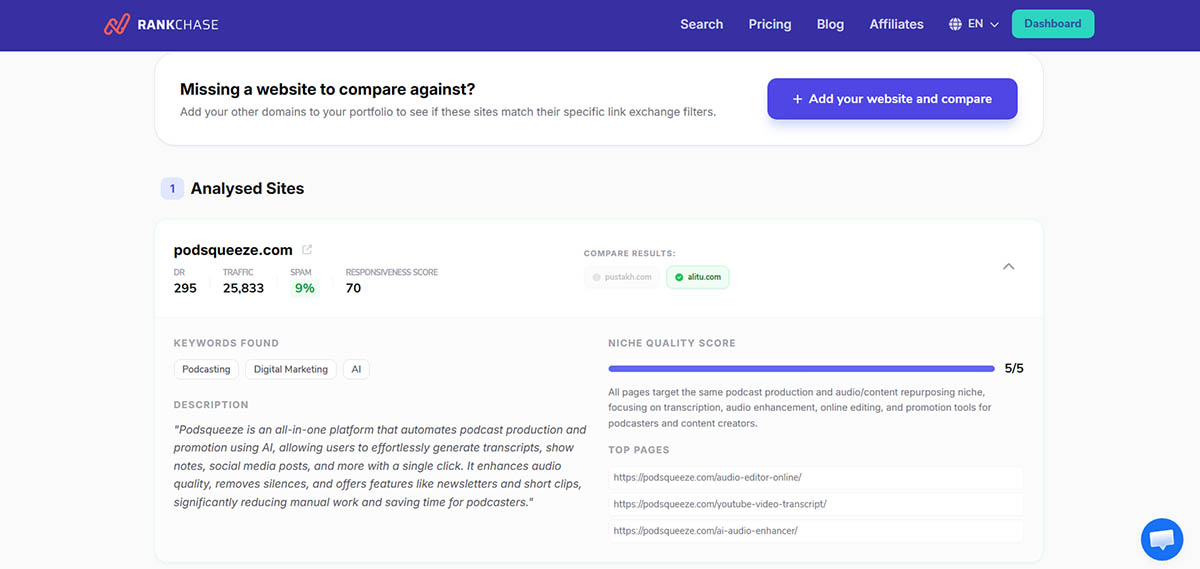
A useful heuristic is this: prefer a site with 3,000 relevant monthly visits over a site with 20,000 vague or mismatched visits.
Assessing Niche Relevance and Outbound Link Ratios
Relevance is the filter that protects both performance and risk.
A site can have good metrics and still be a poor fit if the audience overlap is weak. For link swaps, relevance is not just “same broad industry.” You want one of these:
- Same niche
- Adjacent niche with shared intent
- Different niche but clear page-level overlap
For example, a SaaS analytics blog linking to a CRM implementation guide can make sense. A pet food blog linking to a B2B payroll platform usually does not.
Then check outbound behavior. Ahrefs’ batch analysis highlights outgoing linked domains and outgoing links, which is useful because outbound patterns often reveal whether a site is curated or monetized like a link inventory.
Use this quick test:
- Read 3 recent articles
- Count external links
- Ask whether those links improve the article or feel inserted
- Look for casino, crypto, payday, essay-writing, or unrelated SaaS links in otherwise normal posts
If you keep seeing unrelated external links, move on.
A clean prospect usually has:
- topical consistency
- normal editorial links
- no obvious “write for us + link insertion” footprint
- a reasonable number of outbound links per post
Top Channels for Sourcing High-Quality Link Partners
Once your standards are set, partner sourcing gets easier because you know what to ignore.
SEO Slack Groups and Private Discord Communities
These communities can work well because you get access to active practitioners, not just scraped prospect lists. But quality varies wildly.
The best communities have some friction to join, clear promotion rules, and a culture where people share site details upfront. The worst ones are just constant link-trading threads with no standards.
What I look for inside a private group:
- people state niche, DR, traffic, and target pages clearly
- conversations include fit, not just metrics
- members are open to content collaboration, not only swaps
- spammy niches are either filtered or called out fast
The workflow is simple. Post a tight ask, not a vague one.
Bad: “Looking for link exchange partners. DM me.”
Better: “B2B SaaS site, DR 42, mostly US traffic, looking for partnerships with CRM, RevOps, sales enablement, or customer success sites. Prefer contextual placements in existing content or fresh guest contributions.”
That one message pre-qualifies a lot.
If you use communities often, keep a sheet with columns for niche, DR, traffic, top country, contact, and notes on outbound quality. You will forget who was solid otherwise.
Facebook Groups Dedicated to Link Building
Facebook groups still surface opportunities, but they are noisier than private communities. Expect more resellers, middlemen, and people posting giant spreadsheets of sites they barely control.
That does not mean the channel is useless. It means your screening needs to be tighter.
A practical rule here is never negotiate off the headline metric alone. When someone posts “DR 70, traffic 20K,” ask for:
- domain
- sample placement pages
- top country
- whether they own the site or are brokering it
- whether the placement is in existing content or newly published content
If the answers are vague, skip the thread.
The best use of Facebook groups is not mass outreach. It is spotting repeat posters who consistently share relevant sites and communicate clearly. Over time, those people become better sources than one-off traders.
Vetted Link Exchange Platforms and Marketplaces
Platforms can save time if they help you filter by relevance, authority, traffic patterns, and spam signals before you ever start a conversation.
This is where automated matching is useful. Instead of manually checking hundreds of random domains, you can narrow the list to websites that already fit your niche and metric floor. A platform like Rankchase is helpful in that kind of workflow because it surfaces partner opportunities using signals like niche relevance, DR, traffic patterns, and spam indicators rather than encouraging indiscriminate exchanges.
That said, no platform replaces manual review. Use platforms to shortlist, then vet each candidate page by page.
A good marketplace workflow looks like this:
- Set your niche and metric minimums.
- Review only sites that match topical intent.
- Open their top pages and recent posts.
- Check link placement quality.
- Confirm the contact is responsive and understands editorial context.
If the platform makes every site look equivalent, that is a warning sign. The whole point is selectivity.
Cold Email Outreach and LinkedIn Networking
Cold outreach still works, especially when you are targeting real operators in a tight niche. It just needs to sound like you looked at the site.
My best cold messages usually come after I find a page on their site that is already one update away from linking to my asset. That gives me a reason to reach out beyond “want to trade links?”
A simple prospecting pattern:
- Find sites ranking for adjacent terms
- Open the pages that rank
- Ask whether your resource genuinely fills a gap in that page
- If yes, contact the editor or founder with one specific suggestion
LinkedIn helps when the site has no visible outreach path. Search for content managers, editors, SEO leads, or founders. Keep the message short and move the actual pitch to email when possible.
Cold outreach works better when you target people who publish content, not generic info@ inboxes.
How to Structure Safe and Effective Link Swaps
Once you find a plausible partner, structure matters. The wrong setup creates obvious patterns. The right setup looks like normal publishing.
Direct Reciprocal Links (And When to Use Them)
Direct reciprocal links are the simplest form: Site A links to Site B, and Site B links to Site A.
Use them sparingly and only when both links make sense independently.
Good use case:
- two relevant sites
- different articles
- each article benefits from citing the other
- anchors are natural
- links are not forced into thin content
Bad use case:
- both sites publish low-value posts just to insert the links
- the pages are unrelated
- anchors are exact-match money terms
- the relationship repeats across many pages
If you do a direct swap, keep it boring in the best way possible. One contextual link inside a useful article is enough. You do not need footer links, author bio stuffing, or homepage placements.
Three-Way (ABC) Link Exchanges
Three-way exchanges reduce the obvious one-to-one footprint.
Example:
- Site A links to Site B
- Site B links to Site C
- Site C links to Site A
This structure is common because it gives each party flexibility. It also works well when one company manages multiple content properties.
But a three-way exchange is only safer when the pages still make editorial sense. If the links are random, the pattern is still low-quality, just slightly less visible.
Use ABC exchanges when:
- you have more than one legitimate site or publishing relationship
- you want cleaner separation between giving and receiving
- each placement can live on a page that naturally supports the destination
Do not use ABC structures to justify weak placements. The page has to stand on its own first.
Guest Post and Content Collaborations
This is usually the cleanest option because the value exchange is content-first.
Google has been clear that guest posts are fine when they inform readers or reach another audience, but they become problematic when they are done at scale mainly to build links, especially with keyword-heavy anchors.
So the safe version looks like this:
- pitch a topic the host site would plausibly publish anyway
- write something aligned with their audience
- include only the links that improve the piece
- use branded or natural anchors
- avoid repeating the same template across many sites
In practice, content collaborations work best when both sides bring something.
For example:
- one site contributes subject matter expertise
- the other site contributes original data or examples
- each publishes a complementary asset
- links point where the reader would logically want more depth
That structure produces stronger pages and fewer regrets.
Vetting Prospects to Avoid SEO Penalties
This is the section most people rush, and it is where most mistakes happen.
Identifying Link Farms and Manipulated Metrics
A link farm rarely introduces itself as one. It shows up as a “great opportunity” with nice DR and suspiciously weak substance.
Common signs:
- traffic looks disconnected from the site’s stated niche
- articles cover random industries with no editorial identity
- authors look fabricated or generic
- posts exist mainly to host external links
- top pages are odd, outdated, or off-topic
- indexing looks thin compared to site size
Semrush’s documentation reflects the same core idea: strong-looking domain metrics are not enough if the broader link profile and quality signals point to manipulative behavior.
Here is the fastest red-flag table I use:
If you spot three or more red flags, stop there.
Reviewing the Inbound-to-Outbound Link Ratio
You do not need a perfect ratio. You need a sensible pattern.
A site that earns links but barely links out can still be fine. A site that links out aggressively across most posts is often monetizing placements too hard.
Check this manually with a sample:
- 5 recent blog posts
- 5 older posts
- 2 high-traffic pages
- homepage and category pages
Ask:
- How many followed external links appear per article?
- Are they concentrated around commercial anchors?
- Do links point to related resources or random businesses?
- Does the site seem to publish pages mainly as containers for external links?
This is where page review beats tools. Tools can show outgoing linked domains, but only a manual pass tells you whether the links feel natural. Ahrefs batch analysis is useful for narrowing the list before that manual review.
A good heuristic for editorial blogs is that most posts should link out only when the article benefits from it. If almost every post contains several followed links to commercial domains, that is not editorial restraint.
Steering Clear of Excessive Link Arbitrage
Link arbitrage happens when a site treats content like inventory and links like products. Sometimes they buy guest posts cheaply, inject outbound links later, and sell placements repeatedly across the archive.
This is where things get risky fast because your link may sit beside future placements you would never approve.
Watch for these patterns:
- “existing post insertion” offered on hundreds of URLs
- same site selling links across many unrelated categories
- obvious broker language with no editorial discussion
- pricing tiers tied only to DR and traffic
- old posts updated with unrelated outbound links
Google’s spam guidance makes the broader risk clear: when links exist mainly to manipulate rankings, automated systems may ignore or neutralize their value, and in some cases sites can lose visibility.
If a prospect behaves like a media property, fine. If it behaves like a vending machine, pass.
The safest swap is one you would still make if search engines did not count links at all.
Crafting a Winning Link Exchange Outreach Pitch
By the time you reach out, half the work should already be done. You should know why the fit is real, what page you want, and what you can offer back.
Highlighting Your Site's Value Proposition
Most outreach fails because it only talks about what the sender wants.
A better pitch gives the other site a reason to say yes. That reason can be:
- your content fills a gap in one of their pages
- you can contribute a high-quality article for their audience
- you can reference their guide in a page update you are already making
- your audience overlaps with theirs
- your site has stronger page-level relevance than your raw DR suggests
This part matters more for high-DR sites than people expect. Stronger sites get a lot of generic asks. They respond to relevance and clarity.
Use this mini-checklist before sending any outreach:
- Did I name the exact page I am referring to?
- Did I explain why my page adds value to that page?
- Did I describe my site in one useful sentence?
- Did I avoid sounding like I send 200 emails a day?
Also, be honest about your metrics. If your domain is smaller but highly relevant, say that. Good partners care about fit.
Example Outreach Email Template for High-DR Partners
This template works because it is specific, short, and easy to reply to.
Subject: possible content fit for [Their Site]

Hi [First Name],

I was reading your piece on [Article Title] and noticed you cover [specific subtopic] in a way that overlaps with what we publish at [Your Brand].

We recently put together [Your Article/Page], which goes deeper on [specific angle]. I think it could fit naturally in the section about [exact section or paragraph topic] if you’re updating that page.

For context, our site focuses on [brief niche description], and we’d be happy to look for a relevant way to reference one of your resources from our side as well, either through a contextual update or a future collaboration where it makes sense.

If helpful, I can send over the exact paragraph where I think the fit is strongest.

Best,
[Name]
A few practical notes:
- Keep the subject line plain.
- Mention one page, not five.
- Offer a reciprocal opportunity, but do not force it into the first sentence.
- Do not lead with DR bragging.
- If they reply positively, move quickly with the exact page and anchor suggestion.
When the fit is strong, I usually send the follow-up in this format:
- target page on their site
- suggested insertion point
- my page URL
- one-sentence reason it helps the reader
- optional page on my site where I can reference theirs
That removes friction and makes you look organized.
The whole process comes down to disciplined filtering. Set your metric floor, verify real traffic, confirm page-level relevance, inspect outbound behavior, and only then propose a swap structure that reads like normal publishing. Do that consistently, and link exchanges become a selective partnership tactic instead of a messy numbers game.