How to Find Real SaaS Link Building Partners

Finding SaaS websites for link building sounds easy until you start doing it for real.
You search for “write for us,” open a few tabs, and within 20 minutes you are staring at sites with vague author bios, recycled AI content, no product pages, and backlink profiles full of casino anchors. That is the part most guides skip. The problem is not finding websites. The problem is finding real SaaS companies that are worth building relationships with.
This article walks through the process the way practitioners actually do it. You will learn how to separate legitimate SaaS brands from link sellers, where to source quality prospects, and how to spend your time on partnerships that can realistically move rankings, referral traffic, and pipeline.
If you want the short version, here it is: look for real products, real audiences, and real editorial reasons to link. Google’s spam policies specifically call out excessive link exchanges and partner pages created only for cross-linking, so your process has to stay selective and editorially justified, not transactional at scale.
TL;DR
- Verification: Separate real software vendors from affiliate shells by checking for pricing pages, help centers, and G2/Capterra listings.
- Alignment: Prioritize partners who share your buyer journey but aren't direct competitors (e.g., CRM + Cold Email tools).
- Sourcing: Use Product Hunt for early-stage awareness-building startups and Slack communities for relationship-based distribution.
- Integration Advantage: The cleanest links come from existing business relationships like integration pages, setup guides, and co-marketing case studies.
- Vetting Rule: If you cannot explain the product, buyer, and business model within two minutes, skip the outreach.
What Are SaaS Link Building Partnerships?
A SaaS link building partnership is a working relationship between two software companies, publishers, consultants, or adjacent brands that results in contextual, useful mentions and links.
Sometimes that looks like a guest contribution. Sometimes it is a co-marketing asset, an integration page, a comparison article, a webinar recap, a research post, or a product mention inside an article where the link genuinely helps the reader. The format matters less than the intent. If the link exists because the content is better with it, you are in healthy territory. If the link exists only because both sides wanted “one more DR 60 link,” you are on thin ice.
In B2B SaaS, the best partnerships usually happen between businesses that share a buyer journey without being direct competitors. Think CRM plus sales engagement, data enrichment plus outbound tools, payroll plus HRIS, or analytics plus experimentation software. Those relationships create natural reasons to cite each other in content.
A useful mental model is this:
That distinction matters because not every link partnership is manipulative. Google discourages excessive reciprocal linking for ranking purposes, not normal web relationships where relevant businesses reference each other in useful content.
Why Quality Link Building Matters for B2B SaaS Growth
B2B SaaS SEO is competitive for one simple reason: most bottom-funnel keywords are crowded with strong domains, mature content teams, and product-led pages.
You are not just trying to rank a blog post. You are trying to build enough authority for comparison pages, solution pages, feature pages, template libraries, and category content to compete over time. That takes links, but not just any links.
A single link from a relevant SaaS blog, integration partner, industry publication, or high-trust software directory-adjacent site can outperform a pile of junk links because it does three jobs at once:
- It helps search engines understand topical relevance.
- It can send qualified referral traffic.
- It creates brand familiarity with the exact audience you want.
This is where many teams waste budget. They buy volume, celebrate the spreadsheet, and six months later the traffic graph does nothing. Usually the issue is one of three things:
- The linking sites had no real audience
- The links came from pages with no topical relationship
- The placements were too obviously manufactured
For SaaS, quality matters more because sales cycles are longer and search intent is narrower. If you sell finance automation software, a contextual mention from a real accounting operations publication or a complementary fintech SaaS blog is far more valuable than a generic “business tips” site.
A good decision rule is to ask: would I still want this mention if Google ignored the link completely? If the answer is yes because the audience fit is strong, the page is real, and the brand association helps, it is probably a good opportunity.
If a prospect cannot send qualified humans, it needs to be exceptionally strong in relevance and trust to earn your time.
How to Evaluate Legitimate SaaS Partner Websites
This is the filter that protects your campaign.
A lot of sites look fine on the surface. Nice design, decent DA or DR, some traffic estimate, maybe even a polished outreach email. But once you look at the details, you realize the site is built for link inventory, not for users.
Your job is to vet like an operator, not like a spreadsheet.
Assess Partner Backlink Quality Over Pure Quantity
Do not start with Domain Rating. Start with backlink quality and meeting DR requirements that align with your site's current authority.
Open the prospect’s top linked pages and latest blog posts. Check whether they earn links from relevant software, business, tech, and industry sites, or whether their profile is inflated by low-quality directories, syndicated junk, foreign-language noise, and irrelevant guest post farms.
You are looking for patterns, not one-off anomalies.
Quick vetting checklist:
- Do their referring domains make sense for their niche?
- Do they have branded anchors and natural URL anchors, not just commercial phrases?
- Are links pointing to meaningful assets, not only homepage and random blog posts?
- Does the site publish content that could genuinely attract links?
- Do recent posts have signs of editorial care, or are they thin and mass-produced?
If I see a site with DR 70 but every post has awkward outbound links to unrelated software, agencies, crypto tools, and online casinos, I am out. If I see DR 38 with a clean niche, actual product knowledge, and sensible outbound linking, I keep talking.
This is one reason a filtered workflow helps. A platform like Rankchase can narrow the list by signals such as niche relevance, authority, traffic patterns, and spam indicators, which saves time before manual review. But you still need human judgment on the final shortlist.
Verify Actual Software Products and SEO Performance
A surprising number of “SaaS sites” are not really software companies. Some are affiliate shells. Some are agencies with a software-style homepage. Some are expired domains wearing a new logo.
You need proof that the business is real.
Here is the fastest way to check:
Step 1: Visit the homepage and product pages.
Look for clear use cases, pricing or demo flows, screenshots, integration details, customer proof, docs, changelog, or help center.
Step 2: Search branded queries.
If the company has almost no branded footprint, no reviews, no founder presence, no product mentions, and no indexed product content, be cautious.
Step 3: Check whether the site ranks for topics related to its product.
A real SaaS company may not be crushing SEO, but it usually ranks for some combination of branded terms, feature terms, comparison pages, integrations, templates, or thought leadership topics.
Step 4: Look for third-party validation.
G2 organizes products across extensive software categories, and Capterra states that listings are created for products or services featured in their categories, with fit determined through research on the vendor’s site. That makes both useful places to confirm whether a company is operating like an actual software vendor.
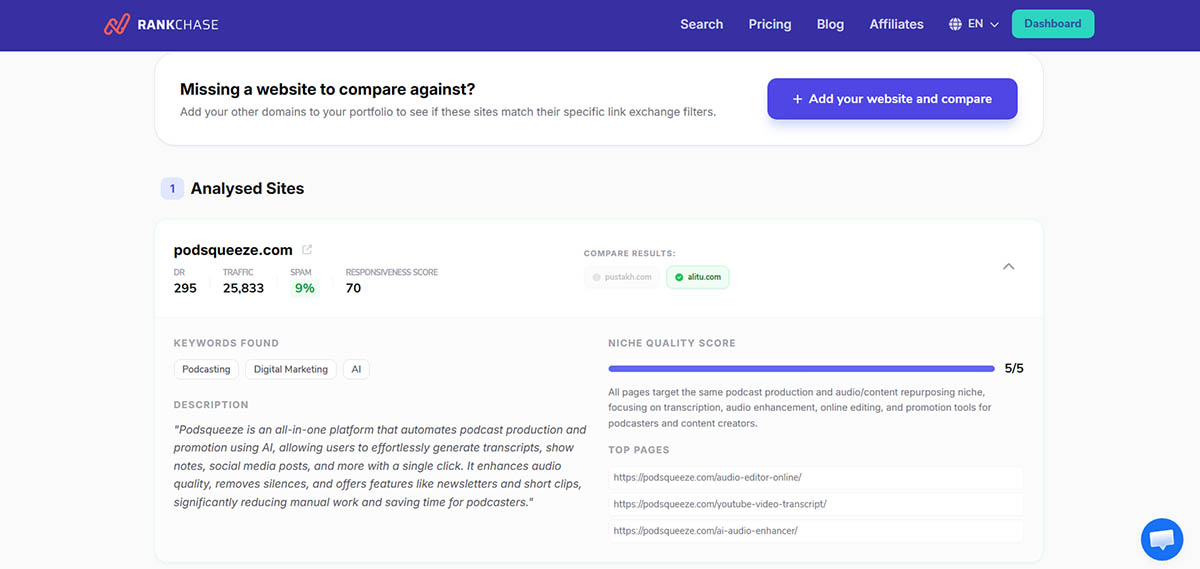
For a faster technical check, you can also run these domains through our Bulk Domain Checker. It allows you to verify DR and traffic at scale, while the Niche Quality Score helps you confirm if the SaaS blog's traffic is coming from relevant product keywords or unrelated filler content.
A simple heuristic I use: if I cannot explain what the product does, who buys it, and how it makes money within two minutes on the site, it is not ready for outreach.
Ensure Niche Alignment with Your Target Audience
This is where strong campaigns separate themselves.
The best link partner is rarely the site with the biggest authority score. It is the one that sits close to your buyer. Same job title, same workflow, same stack, same pain point, or same evaluation stage.
Say you sell revenue intelligence software. These are not equally good prospects:
- A general entrepreneurship blog
- A SaaS finance blog
- A sales operations software company
- A B2B data vendor
- A CRM consultancy with a real audience
The last three are usually better because the overlap is tighter.
To evaluate alignment, ask three questions:
- Would their audience ever buy our product?
- Would our audience benefit from their product or content?
- Can we create something that makes sense on both sites without forcing the link?
If the answer is yes to all three, you likely have a good fit.
A quick scoring model helps. Give each prospect 1 to 5 points for relevance, product legitimacy, organic visibility, editorial quality, and relationship potential. Anything under 18 out of 25 usually goes to the reject pile.
10 Best Ways to Find Real SaaS Link Partners
Once your vetting criteria are clear, prospecting gets much easier. You stop collecting random domains and start building a list you can actually use.
1. Leverage B2B SaaS Marketing Slack Communities
Private communities are one of the fastest ways to find legitimate operators because bad actors tend not to last in rooms where practitioners know each other.
The move here is not to join and immediately ask for links. That burns trust fast. Instead, look for conversations around content promotion, partnerships, integrations, webinars, affiliate programs, and SEO collaboration. Those are signals that people are open to relationship-based distribution.
A practical workflow:
- Join a few relevant B2B SaaS or growth communities
- Watch who gives useful answers consistently
- Click through to their company site
- Vet them using the framework above
- Start a direct conversation around content fit, not link exchange
The quality advantage is huge because communities surface people who are already active in marketing, partnerships, or content. You skip a lot of cold-start friction.
2. Mine Software Directories Like G2 and Capterra
Software directories are excellent for one reason: they force you into a real product universe.
G2 organizes products across a wide set of software categories, and Capterra says it covers more than 900 software categories with verified reviews and category-based discovery. That makes them strong places to build niche prospect lists around adjacent products, subcategories, and integration-friendly solutions.
Here is the mini-workflow:
- Pick your category and one layer of adjacent categories.
- Export or collect vendors that fit your ICP overlap.
- Visit each site and identify content maturity.
- Prioritize vendors that publish educational content, comparison pages, templates, or integration pages.
- Reach out with a specific collaboration angle.
Example: if you sell employee scheduling software, do not stop at “employee scheduling.” Check HR, payroll, time clock, workforce management, onboarding, and internal communication tools. The audience adjacency is often where the best partnerships live.
3. Reverse-Engineer Competitor Backlink Profiles
This is still one of the highest-yield tactics because your competitors have already validated the market.
You are not copying links blindly. You are studying which types of sites actually link to SaaS brands in your category.
You want placements that suggest editorial discretion, rather than domains that link to every SaaS brand under the sun from low-quality listicles.
4. Use Advanced Google Search Operators for Tech Blogs
Search operators still work well if you use them with intent.
Most people type broad terms and get junk. You want queries that combine niche, format, and business type.
Examples:
site:.com SaaS "guest post""sales ops" software blog"HR tech" intitle:blog"CRM integration" "software""B2B SaaS" "write for us""alternative to" + [competitor category]
Then filter manually. You are looking for blogs tied to real companies, not generic content sites.
My rule is simple: if the search result snippet does not immediately suggest product expertise or a known audience, I do not open it.
Use operators to find pages in formats that naturally support links:
- integration pages
- use case pages
- partner resources
- statistics pages
- original research
- template libraries
- implementation guides
Those tend to produce better placements than generic opinion posts.
5. Connect with SaaS Content Managers on LinkedIn
This works because partnerships usually happen through people, not domains.
When you find a good prospect, identify the content lead, SEO manager, partnerships manager, or demand gen lead. A warm, relevant message to the right person beats a generic “hello editor” inbox every time.
Your first message should do one thing well: prove you understand their audience.
Bad outreach sounds like this: “We would love to exchange backlinks with your high-authority website.”
Good outreach sounds like this: “We noticed you publish tactical content for RevOps teams. We are working on a dataset around CRM hygiene benchmarks and thought your audience might find it useful. If it fits, we could also contribute a practitioner piece on enrichment workflows.”
LinkedIn remains a useful platform for professional networking and company outreach, and recent trust features like profile verification can add confidence when you are assessing whether the contact is legitimate.
6. Source Leads from Recent Product Hunt Launches
Product Hunt is underrated for finding newer SaaS companies that are actively building awareness.
It is not a pure SEO source. That is exactly why it is useful. You can discover startups before they appear on every prospecting list.
Product Hunt’s launch resources show that makers can submit their own products, schedule launches in advance, and build launch pages around real product URLs. Their product discovery pages also make it easy to browse recent launches by month.
How to use this without wasting time:
- Look for products launched in the last 3 to 9 months
- Prioritize companies with a clear SaaS model and content ambitions
- Check whether they already have a blog, docs, integrations, or comparison content
- Reach out while they are still in active awareness-building mode
These companies are often more open to collaborations because they are still building authority and distribution.
7. Build Relationships Through Complementary Integrations
This is one of the cleanest link opportunities in SaaS because the business relationship already exists.
If your product integrates with another platform, there are multiple natural link placements:
- integration landing pages
- setup guides
- use case content
- help docs
- partner directories
- co-marketing case studies
The reason this works so well is simple. Integrations create genuine user value. If customers actually use both tools together, linking between relevant resources is normal and useful.
A smart workflow is to ask your product or partnerships team for a list of current integrations, planned integrations, and top requested integrations. Then build a content plan around that ecosystem. You will often find link opportunities that do not require cold outreach at all.
8. Monitor SaaS-Specific Networking Groups
Beyond Slack, there are founder groups, marketing circles, operator communities, and niche associations where SaaS teams share launches, research, and collaboration requests.
The best use of these groups is not volume prospecting. It is signal detection.
Look for people asking questions like:
- Who wants to co-host a webinar?
- Does anyone have benchmark data for this topic?
- We just released an integration and want launch partners
- Looking for expert contributors for a comparison page or report
Those posts reveal active collaboration intent. That is far better than guessing who might respond to a cold pitch.
Just keep your standards high. Activity does not equal quality. Run the same legitimacy checks before moving a site into outreach.
9. Pitch Digital PR Campaigns to Tech Publications
If you want links that compound authority, build stories instead of just asking for placements.
Tech publications and niche B2B media outlets care about fresh data, expert commentary, and category trends. So if your team can publish original research, benchmark reports, product usage trends, or commentary on a timely shift in your market, you can attract links from sites that would never entertain a “link exchange” conversation.
This works especially well in SaaS when the asset has one of these traits:
- proprietary data
- strong category insight
- a clear angle tied to a business problem
- credible subject matter experts behind it
A simple digital PR formula:
dataset or insight + clean narrative + fast expert quote + outreach to tightly matched publications
You will spend more time on the asset, but the upside is much higher. One solid campaign can produce links, mentions, referral traffic, and repurposable content for months.
10. Partner with a Specialized B2B SaaS Link Agency
Sometimes the constraint is not knowledge. It is bandwidth.
If your team already knows what good looks like but cannot source, vet, and manage outreach consistently, a specialized B2B SaaS link agency can help. The keyword is specialized. A generalist vendor that treats fintech, ecommerce, local SEO, and SaaS the same way usually creates messy outcomes.
When evaluating an agency, ask for process, not promises.
You want to know:
- How they source prospects
- How they assess niche fit
- Whether they reject sites with spam signals
- What content formats they use
- How they handle reciprocal opportunities
- What reporting looks like beyond link count
If they talk only about DR targets and delivery volume, keep looking.
What to Expect: Time Investment and Link ROI
Good SaaS partnerships take time because relationship-based SEO is slower than buying placements, but the payoff is stronger and usually more durable.
Here is a realistic expectation range for an in-house or lean agency workflow:

That timeline gets faster once you build a trusted network.
ROI also needs the right lens. Do not judge partnership links only by “did this one URL move from position 8 to 5?” In SaaS, the return often shows up across multiple layers:
- stronger category page visibility
- improved crawling and discovery of new content
- referral traffic from relevant audiences
- assisted conversions from branded search
- easier future outreach because your brand is more recognizable
A practical benchmark is to tag every link opportunity by relevance, authority, effort, and business upside before you pursue it. That prevents you from sinking ten hours into a site that looks impressive but has no actual audience fit.
If you need a simple filter, use this:
Say yes when the site is real, the audience overlaps, the page format makes sense, and the relationship can extend beyond a one-off link.
Frequently Asked Questions About SaaS Link Partnerships
Are link exchanges always bad for SaaS SEO?
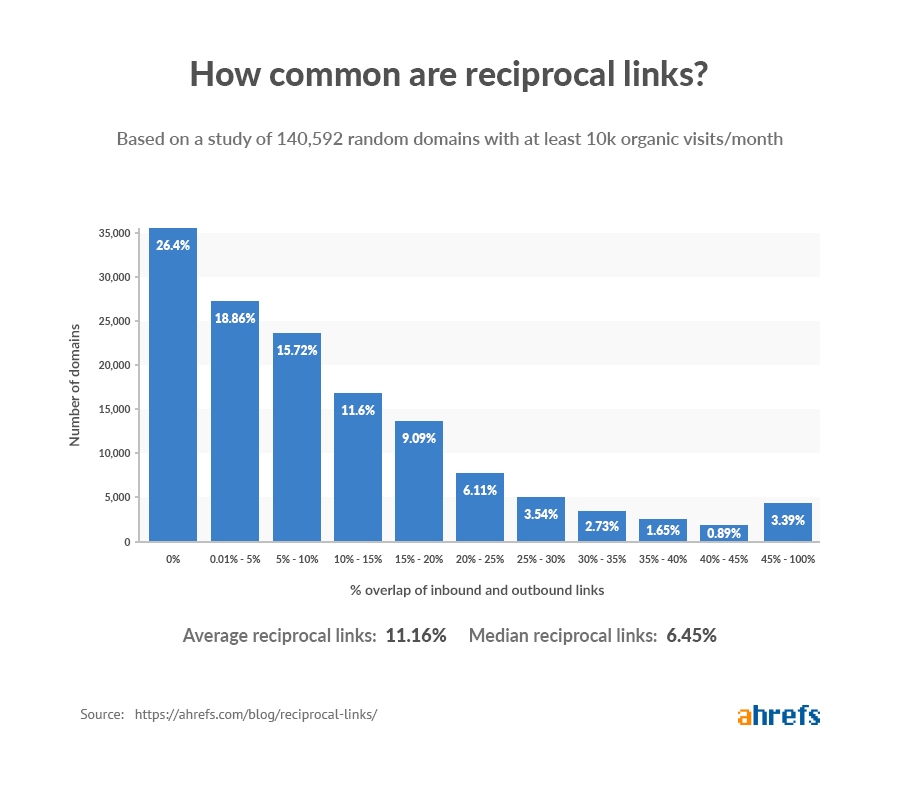
No. What Google flags is excessive link exchanges or partner pages created only to cross-link for rankings. Relevant, editorially justified links between related businesses are common and normal. The safest approach is to keep partnerships selective, contextual, and useful to readers.
How many SaaS partner sites should I contact each month?
For most teams, 30 to 80 highly filtered prospects is better than blasting 500. Quality outreach depends on real fit, and personalization breaks when your list gets too broad.
What metrics matter most when vetting a SaaS link partner?
Start with relevance, product legitimacy, content quality, and backlink cleanliness. Authority metrics help, but they are secondary. A lower-metric site with a real SaaS audience often beats a stronger-looking site with no buyer overlap.
Should I prioritize SaaS companies or media sites?
Both. SaaS companies are often easier to collaborate with because the audience overlap is clearer. Media sites can drive larger authority gains. A balanced profile usually includes product partners, industry publishers, consultants, and data-driven PR wins.
How do I know if a site is selling links?
Common signs include vague editorial standards, unrelated outbound links in many posts, pricing language during the first reply, unnaturally broad topic coverage, and content that looks built to host placements instead of help readers.
What content formats work best for SaaS partnerships?
Integration pages, comparison articles, original research, use case guides, template pages, webinars, expert roundups, and genuinely useful guest contributions tend to work well because they give both sides a clear reason to participate.
Can a platform help with prospect discovery without turning into link farming?
Yes, if it filters for relevance and quality rather than just volume. The right workflow helps you narrow down potential partners using signals like niche fit, authority, traffic patterns, and spam indicators, then lets you manually review the shortlist before outreach.
How long does it take to see results from SaaS link partnerships?
Expect several weeks to secure placements and a couple of months to see clearer SEO impact. Referral traffic and relationship value can appear earlier, especially when the partner has an engaged audience.
Should early-stage SaaS companies use Product Hunt and software directories for link prospecting?
Yes, both can be useful. Product Hunt helps you discover newer software companies and launch-active teams, while software directories help you map the category and validate whether a company is operating like a real vendor.
What is the biggest mistake teams make here?
They optimize for link count before they optimize for partner quality. Once you flip that, the whole campaign improves. Your outreach gets sharper, your placements get cleaner, and your links start supporting real growth instead of just filling a monthly report.