How to Structure ABC Link Exchanges Correctly for SEO

ABC link exchanges can work when they are relevance-first, limited in volume, and editorially justified. They become a problem when people treat them like a factory line, especially when excessive link exchanges are used primarily to manipulate rankings.
That distinction matters because Google’s spam policies specifically warn against excessive link exchanges intended to manipulate rankings, while Google’s broader link guidance still reflects the fact that links remain a core way pages are discovered and understood. Google also recommends natural anchor text and warns against stuffing keywords into links.
So if you want to use ABC exchanges, the job is not to hide a bad tactic. The job is to structure a small number of relevant, useful cross-site placements that make sense even if no SEO value existed.
TL;DR
- Mechanism: ABC trades use an indirect path (A→B→C→A) to break the direct 1-to-1 reciprocal footprint.
- Safety Nuance: Structure alone doesn't hide low quality; Google can detect circular patterns if timing, IP ranges, and anchor text are repetitive.
- Best Use Case: Ideal for teams managing multiple legitimate properties or active guest posting channels where editorial fit is primary.
- The "Asset" Rule: Only use secondary sites that have their own audience and purpose; abandoned shells act as footprints, not shields.
This guide walks through that process the way practitioners actually handle it: how the structure works, when it makes sense, how to set it up, and how to keep your footprint clean.
Understanding the Basics of 3-Way Link Swaps
Before you worry about outreach or tracking, you need the structure right. Most problems with link exchanges happen because the operator starts from “how do I get a link” instead of “how do I build a defensible path between related sites.”
What Exactly is an ABC Link Exchange?
An ABC link exchange is a 3-way link arrangement between separate sites.
The basic pattern looks like this:
- Site A links to Site B
- Site B links to Site C
- Site C links to Site A
Sometimes one of those sites is a secondary asset owned by one of the parties. Sometimes all three sites belong to three separate website owners. The core idea is simple: the link relationship is indirect, not one-to-one.
That indirect structure matters because it avoids the obvious “you link to me, I link to you” pattern that direct reciprocal linking creates.
In practice, the strongest ABC exchanges are not built at the homepage level. They are built between specific, topically aligned pages. For example, a SaaS site with an article on onboarding templates links to a workflow guide on a project management blog, which links to a resource page on a CRM blog, which links back to the SaaS site’s implementation checklist. That can look natural because each page serves the same user journey.
The weak version is when three unrelated domains shove links into random blog posts just to complete the loop. That is exactly the kind of footprint that gets ignored at best and treated as manipulative at worst.
How Does It Differ from Direct Reciprocal Linking?
Direct reciprocal linking is the classic A ↔ B arrangement. Two sites exchange links with each other.
ABC linking changes the graph. Instead of a visible two-way trade, each site gets a link from a different domain than the one it linked out to. That makes the exchange less mechanically obvious, but it does not magically make a bad deal safe.
If the same owners, same anchor patterns, same article templates, and same thin pages keep showing up, the structure alone will not save you. Google has been explicit that it has gotten better at detecting and nullifying link schemes, which is why the setup has to be sensible at the page level, not just clever on a diagram.
A practical decision rule:
- Use direct reciprocal links when the relationship is real and public, such as partners, associations, suppliers, or cited resources.
- Use ABC structures when both parties have a legitimate content fit, but a direct swap would create an unnecessary reciprocal pattern.
- Do neither when the pages are only being linked to because someone asked.
If you cannot explain the editorial reason for the link in one sentence, skip the exchange.
Why Modern SEOs Prefer the ABC Link Building Method
Once you understand the mechanics, the next question is obvious: why bother with ABC at all?
Because when done carefully, it gives you flexibility that direct swaps do not.
Minimizing Detectable Footprints for Better Safety
Most experienced SEOs moved away from blunt reciprocal swaps years ago because they leave a simple pattern behind. Spreading the relationship across separate domains helps you avoid detectable footprints that algorithms can easily flag.
That does not make them invisible. It just reduces the most obvious footprint.
The safer version usually includes these traits:
- different referring domains
- different page types
- mixed anchor phrasing
- links placed inside relevant content, not author bio junk
- reasonable publishing velocity
- no repeating partner loops every month
A good heuristic is this: if someone exported your last 30 acquired links into a sheet, would they see a system or a website earning links from adjacent sites?
If they would see a system, you need to slow down.
Creating a Natural-Looking Backlink Profile
A backlink profile looks healthier when it reflects varied sources, varied anchors, and varied linking reasons.
That is one reason ABC deals appeal to serious operators. They help avoid filling your profile with obvious mirrored trades from the same cluster of sites.
But you still need to manage the details. Google recommends writing anchor text naturally and not cramming keywords into links. So if every exchanged link uses exact-match commercial anchors, you are creating the problem yourself.
Use this anchor mix as a working model:
- Brand or brand + topic for most partner placements
- Partial-match anchors when the page fit is strong
- Naked URL or generic anchors occasionally
- Exact-match commercial anchors rarely, if ever, in exchange-driven placements
That single choice solves a surprising amount of risk.
Fostering Long-Term Industry Relationships
This is the part newer SEOs underestimate.
The best exchanges rarely come from “link trader” behavior. They come from ongoing content relationships with publishers, consultants, agencies, SaaS companies, and niche site owners who serve overlapping audiences.
When that relationship exists, the exchange becomes one option inside a broader collaboration set:
- guest contributions
- expert quotes
- newsletter mentions
- co-marketing assets
- brand mentions that later become linked
- resource page placements
That is also why partner quality matters more than raw authority. Ahrefs describes Domain Rating as a proprietary score of a domain’s backlink strength relative to other sites in its database, which makes it a useful directional filter, but not a proxy for quality, traffic fit, or editorial standards.
So when you evaluate a partner, think in this order:
- topical fit
- real audience and real content
- clean outbound linking behavior
- then authority metrics like DR
That order keeps you out of a lot of bad deals.
Proven Frameworks: How to Structure Your Exchanges Properly
This is where most people get sloppy.
There is no single “best” ABC model. There are several structures that work, and each fits a different type of site portfolio.
The Classic Three-Site Triangle (Site A → B → C)
This is the cleanest model and the easiest to understand.
Three separate sites each give one link and receive one link. No direct reciprocity. No repeated pair pattern.
Use this structure when:
- all three sites are topically adjacent
- each site has pages that genuinely support the other
- each owner is willing to place contextual links in indexed content
- no one is forcing homepage or sitewide placements
A real-world rule that saves time: do not force the triangle until the pages are mapped first.
Start with page-level compatibility:
- What page on Site A can naturally cite Site B?
- What page on Site B can naturally cite Site C?
- What page on Site C can naturally cite Site A?
If one leg feels forced, the whole triangle is weak.
Leveraging a Secondary Niche Asset
A lot of in-house teams and agencies use a secondary site as one side of the triangle.
For example:
- money site wants a link
- secondary editorial site gives the outgoing link
- partner site links to money site
This can work well when the secondary site is real, maintained, and topically coherent. It works badly when the secondary site is an abandoned shell made only to route equity.
Use a secondary asset only if it passes this test:
- it has its own audience or purpose
- it publishes on-topic content
- its outbound links are selective
- you would still keep the site live if link building disappeared tomorrow
If not, do not use it.
If your secondary site exists only to complete exchanges, it is not an asset. It is a footprint.
Utilizing Active Guest Posting Placements
This is one of the more practical structures in 2026 because many editorial teams already have active contribution channels.
The setup looks like this:
- you place or secure a guest post on Site B
- that guest post links to Site C
- Site C links to Site A through a separate contextual placement
The value here is flexibility. You are not limited to existing owned content. You can create a new page that gives the link in a natural context.
But there is an obvious line you should not cross. Google has warned that large-scale article campaigns and guest posting with the main intent of building links back to the author’s site can violate guidelines. So if you use guest posting inside an ABC structure, the content needs to stand on its own and the links need to be restrained.
Good use:
- original article
- one relevant contextual citation
- strong topical fit
- normal author profile
Bad use:
- spun topic
- keyword-heavy anchors
- same template across many domains
- guest posts existing only to place links
Coordinating Broader Partnership Networks
This is where operations either become efficient or dangerous.
If you manage dozens of partner conversations, you need a system for matching relevance, authority, and risk. Done well, that means a small curated network of niche-aligned sites. Done poorly, it turns into a public swap pool full of junk inventory.
A broader network should be organized around filters such as:
- niche overlap
- DR range
- estimated traffic trend
- outbound link hygiene
- content quality
- spam indicators
- preferred page types
- response reliability
This is also the point where a matching tool can help. If you already run exchange or collaboration workflows at scale, Rankchase can be used as one way to surface niche-relevant partner opportunities based on relevance, DR, traffic patterns, and spam signals, which is more useful than manually sorting through random exchange requests.
The important part is not the tool. It is the standard. The minute the network starts tolerating irrelevant sites because the metrics look shiny, the quality drops fast.
A Step-by-Step Guide to Executing the Strategy
Good structures still fail when execution is loose. This is the operating process I would use if I were setting up a fresh ABC campaign today.
Identifying and Vetting High-Quality Partners
Partner selection is where most of the upside or downside gets locked in.
Start with a simple screening pass. You want sites that are close enough in topic to make editorial sense, but not so similar that every placement looks like a competitor trade.
Use this vetting table:
A few practical checks help here:
Review five recent posts manually. If three of them contain awkward commercial anchors to unrelated sites, walk away.
Check the outbound style, not just the DR. A site can have respectable authority metrics and still be selling placements everywhere. DR alone is a weak filter. Ahrefs itself describes DR as a backlink-strength metric, not a quality score.
Confirm the site actually ranks or gets traffic in its lane. I care less about exact third-party estimates and more about whether the site looks alive, indexed, and thematically consistent.
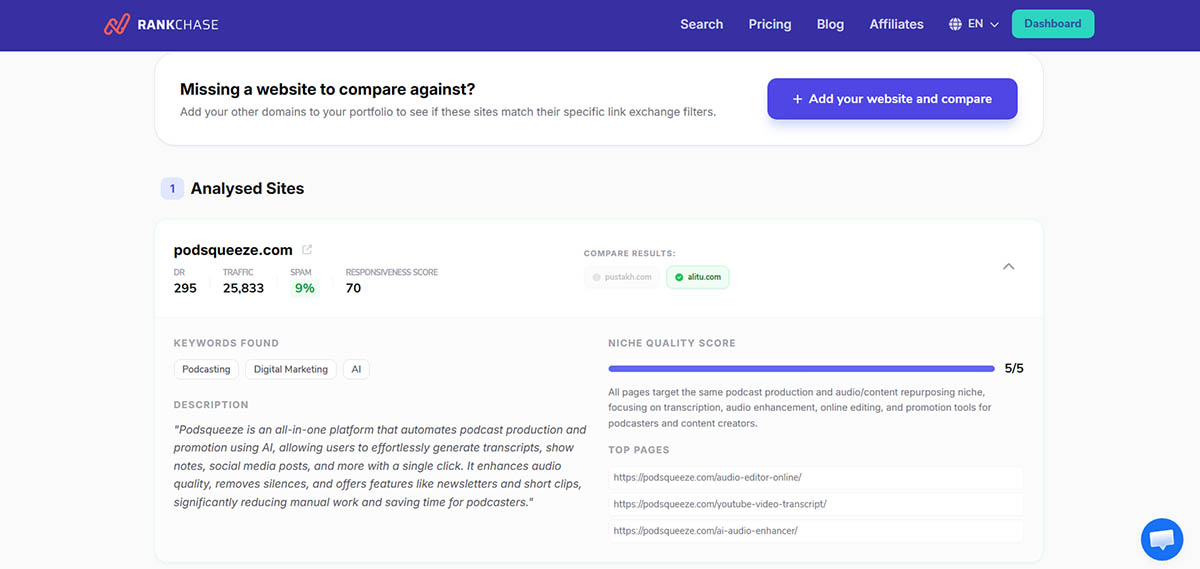
A quick way to verify this is through our Bulk Domain Checker. It gives you a high-level view of DR, traffic, and spam risk instantly. The tool's Niche Quality Score is particularly useful for ABC structures, as it confirms whether the authority of each site in the triangle is backed by relevant, high-quality content.
Short checklist before you contact anyone:
- Topic overlap is obvious
- Site has real editorial content
- Outbound links look selective
- You can name at least one page that could host a relevant link
- You know which asset on your side fits the exchange
If you cannot check all five, keep looking.
Crafting a Compelling Outreach Pitch
Most outreach fails because it sounds like a transaction from line one.
A better pitch sounds like a person who has actually read the site and already knows where the fit is.
Keep the message short. Include three things:
- why their site is relevant
- which page you have in mind
- what you can offer in return without sounding like a broker
A workable outreach angle:
- mention a specific article or content hub
- suggest a precise placement idea
- offer an indirect arrangement if relevant
- make it easy to say yes or no
Example flow:
“Loved your piece on X. We have a page on Y that overlaps with the same audience. I think there’s a clean contextual fit on your article about Z. If helpful, I can also offer a relevant placement from another site in the same niche rather than a direct reciprocal link.”
That feels normal. It also signals that you understand structure without overexplaining the mechanism.
Do not send lists of 20 domains on the first email. Do not talk about “link juice.” Do not lead with anchor text demands. The more operational your message sounds, the less editorial the relationship feels.
Negotiating Placement Details and Structures
This is where a promising exchange either becomes clean or starts collecting risk.
You want to align on five details:
- linking page
- target page
- anchor style
- placement type
- timing
The mistake I see most often is negotiating at the domain level. That is too vague.
Instead, negotiate like this:
- Site B article: exact URL
- Link target: exact URL
- Anchor: branded or partial-match suggestion
- Placement: in-body contextual mention
- Timing: publish/live date and verification date
Anchor text deserves special care. Google’s documentation recommends natural anchors and explicitly warns against cramming every related keyword into them. So when a partner asks for an exact-match money term, my default answer is no unless there is a very unusual editorial reason.
A useful decision rule:
- If the target page is commercial, use brand-heavy anchors.
- If the target page is informational, partial match is usually fine.
- If the sentence sounds unnatural with the anchor inserted, rewrite the sentence or change the target.
Also decide whether the link should be followed. Google provides rel values such as nofollow, sponsored, and ugc to qualify certain outbound links depending on the relationship. If a placement is sponsored or untrusted, it should be qualified appropriately.
Tracking and Verifying the Final Links
Once placements go live, do not rely on screenshots alone.
You need a simple tracking system with these columns:
- partner
- giving site
- receiving site
- source URL
- target URL
- anchor text
- follow/nofollow status
- publish date
- indexed status
- notes
Then verify in layers:
Layer 1: Manual check
Open the page, inspect the placement, confirm the link works, and confirm the context still makes sense.
Layer 2: Indexation check
Make sure the linking page is indexable and not orphaned.
Layer 3: Search Console review
Google Search Console has a Links report that helps site owners review linking domains and pages, though many practitioners know it does not show every link Google knows about. Use it as a directional confirmation, not the only source of truth.
Layer 4: Traffic and engagement check
In GA4, the Traffic acquisition reporting area is where teams typically review where visits are coming from. Referral traffic from a strong contextual placement is a positive sign that the link has user value beyond SEO.
If a placement sends zero clicks, sits on a weak page, and only exists to complete the triangle, ask yourself whether it was worth doing at all.
Essential SEO Best Practices to Keep Your Site Safe
This is the section that separates a selective strategy from a liability.
Prioritize Strict Topical Relevance
Topical relevance is your first filter and your last line of defense.
If the sites do not serve a similar audience, the exchange is already compromised. I would rather take a link from a smaller site that sits squarely in the right niche than from a high-metric domain that publishes on everything.
Use this rule: the linking page should be able to improve the reader’s next step.
Examples that make sense:
- email marketing guide → CRM comparison
- bookkeeping checklist → invoicing software tutorial
- home gym recovery article → mobility equipment guide
Examples that do not:
- legal services page → pet food blog
- casino article → SaaS onboarding guide
- general news post → niche B2B product page with no editorial bridge
When relevance is weak, every other signal has to work harder to defend the placement.
Avoid Over-Optimizing Anchor Text
This is where people sabotage themselves.
Google’s link guidance says to write anchor text naturally and avoid stuffing every keyword related to the page you are linking to. That applies doubly to exchanged links because they already carry intent.
A healthy exchange profile usually looks like this over time:
- brand anchors dominate
- partial matches are present but restrained
- generic anchors appear occasionally
- exact-match commercial anchors are uncommon
If you audit your last 15 exchanged links and see the same money phrase repeated, change course immediately.
Maintain a Healthy Inbound-to-Outbound Ratio
There is no official Google threshold for this, and anyone claiming an exact ratio is making it up.
But there is a practical reality: sites that link out aggressively relative to their editorial depth look suspicious fast.
My rule is simple. On any site used in exchanges, outbound placements should remain a small minority of total contextual links, and they should be spread across genuinely useful articles rather than concentrated in a handful of pages.
Watch for these signs:
- new posts exist mainly to host links
- old posts keep getting edited to insert partner placements
- outbound commercial links are growing faster than new content
- a secondary asset links out far more than it earns natural mentions
If that is happening, the site is drifting toward a network footprint.
Steer Clear of Public Link Farms and Bad Neighborhoods
This one sounds obvious until people start chasing easy supply.
Avoid any environment where sites are openly traded like inventory and editorial judgment barely exists. Google’s webmaster guidance warns site owners to avoid links to web spammers and “bad neighborhoods,” and its current spam guidance continues to target manipulative link behavior.
Red flags that usually mean “leave”:
- public spreadsheets of thousands of exchange-ready domains
- no niche segmentation
- same article template across many sites
- publishers willing to link to anything for anyone
- obvious sponsored or paid placements left unqualified
- heavy use of exact-match anchors across unrelated niches
If a partner says yes before asking what your site does, that is usually not a partner. It is inventory.
Frequently Asked Questions About Indirect Link Swapping
Can Google Algorithms Detect 3-Way Link Exchanges?
Yes, Google can detect many forms of manipulative link behavior, and Google has publicly said it has become better at detecting and nullifying link schemes. An indirect structure is less obvious than a direct reciprocal link, but it is still detectable when the surrounding patterns are sloppy, such as repeated partner loops, keyword-heavy anchors, weak relevance, or large-scale article campaigns built mainly for links.
So the right question is not “can Google detect it?” The right question is “if this placement were reviewed at the page level, does it make editorial sense?”
Will Participating in Link Swaps Lead to a Penalty?
Not automatically.
Google’s guidance targets excessive link exchanges and manipulative link schemes, not every instance where two or more related sites link to each other in the normal course of publishing. Relevant editorial links between related businesses, resources, and publishers are common on the web. The risk rises when the exchange is scaled, repetitive, obviously transactional, or disconnected from user value.
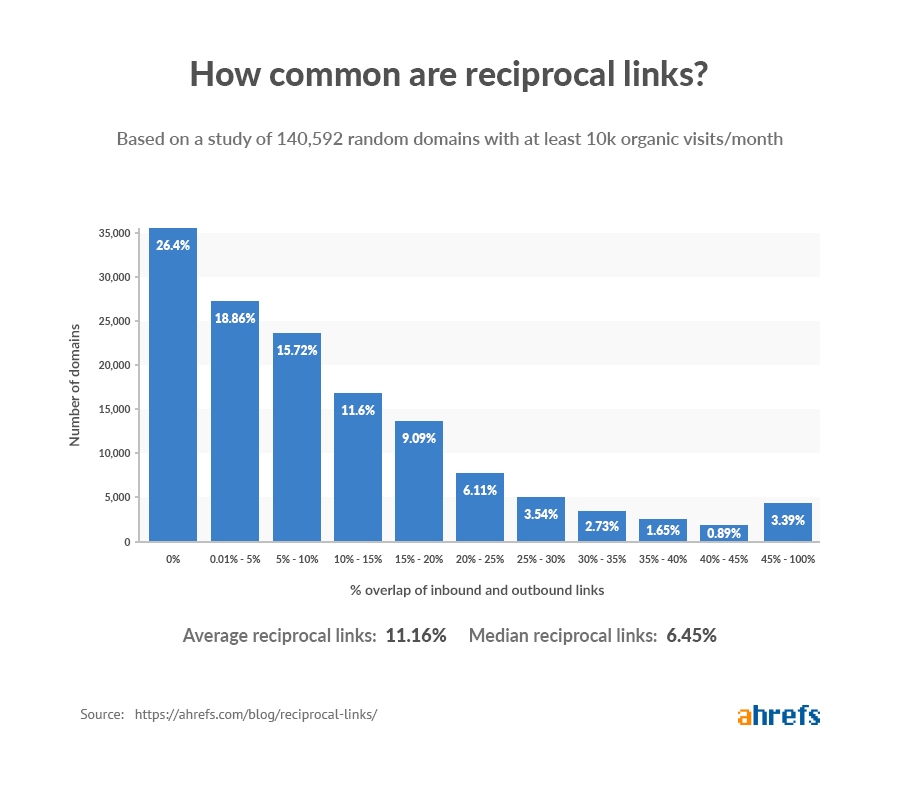
If you keep exchanges selective, page-relevant, and naturally anchored, you are operating in a much safer zone than someone running a volume-based swap program.
What Are the Best Alternatives if I Lack a Secondary Site?
If you do not own a second site, you still have several solid options.
First, build non-exchange linkable assets:
- original data
- free tools
- calculators
- templates
- expert roundups
- statistics pages that deserve citations
Second, use digital PR and expert contribution campaigns to earn links without needing a trade.
Third, pursue guest contributions where the article itself is worth publishing and the link is secondary.
Fourth, build a partner discovery workflow around relevance rather than raw swapping. That might mean working with a curated partner list, agency relationships, or a platform that helps surface adjacent sites worth collaborating with.
A lot of teams default to ABC because it feels faster. But if you do not have a secondary asset and cannot find high-fit partners, forcing the structure is usually worse than waiting and building a better asset first.