How to Find Niche-Relevant Link Exchange Partners

If you have ever said yes to a backlink swap just because the other site had a decent DR, you already know how this goes.
You get a link. They get a link. Nothing meaningful happens.
No rankings move. No qualified referral traffic shows up. Sometimes your outbound profile gets a little uglier. And if you keep doing it at scale, you start building the exact footprint you do not want.
That is the difference between random swaps and niche-relevant partnerships.
A good exchange feels like a real editorial decision. The two sites cover related topics, serve similar readers, and can naturally reference each other without forcing the anchor text or inventing a reason for the link to exist. A bad exchange feels negotiated from the first sentence.
Google’s spam policies are clear that excessive link exchanges done primarily to manipulate rankings fall under link spam. Understanding if reciprocal link building is safe for your site requires a focus on editorial logic. Google also separates that from normal web activity by recognizing that links tied to advertising or sponsorship can exist as long as they are properly qualified.
So the goal is not “never exchange links.” The goal is never exchange links randomly, excessively, or without editorial logic.
This article walks through the process I use when I want partnerships that can actually help a site: how to qualify partners, how to find them, how to pitch them, and how to keep the whole thing looking like what it should be in the first place, which is a useful connection between related sites.
TL;DR
- Relevance over DR: A DR 35 niche-relevant link often outperforms a DR 70 general link due to stronger topical signals and user intent.
- Vetting Ratios: Ideal partners have at least 30-50% content overlap and a clean outbound profile (no casino/crypto clutter).
- Prospecting: Use "Context-Rich" operators to find pages that already discuss your subtopic rather than generic "write for us" pages.
- The "Page-Level" Rule: If the partnership only makes sense at the domain level but not at the page level, it's a footprint risk.
- Actionable Workflow: Run competitor backlink intersects and filter for domains linking to two or more competitors to find active industry peers.
The Danger of Random Swaps vs. The Power of Niche Relevance
Random swaps usually start with the wrong filtering criteria.
Someone is shopping by DR, by total traffic, or by a spreadsheet full of domains pulled from an outreach vendor. None of those things tell you whether a link makes sense on the page, for the reader, or within your site’s existing topic cluster.
Here is what random swapping tends to produce:
- links from adjacent-at-best sites with no real audience overlap
- placements on recycled guest post pages with five external links jammed into the body
- exact-match anchors that look negotiated
- reciprocal patterns that are obvious when viewed in bulk
- no referral traffic and no page-level relevance
That last one matters more than people admit. A relevant link placed on a page that already ranks, gets crawled often, and serves your target audience is a very different asset from a sitewide favor from an unrelated domain.
Let’s make it concrete.
If you run a SaaS for field service management, a relevant exchange partner might be a site that publishes content about HVAC operations, plumbing business growth, contractor scheduling, or invoicing workflows. An irrelevant partner is a general marketing site, crypto blog, casino-adjacent publisher, or “business directory” that links to anything with a budget.
The first group can reference your content naturally. The second group cannot without forcing context.
That is why niche relevance compounds. Relevant partners tend to produce:
- stronger topical signals
- more believable anchors
- better placements inside content that already has search intent
- higher chance of referral clicks from the right audience
- a cleaner long-term backlink profile
I have seen small sites outperform bigger competitors with fewer links simply because their links made sense. They were getting cited by the right kinds of sites, on the right kinds of pages, with anchors that read like normal writing.
If a human editor would struggle to explain why the link belongs there, skip the exchange.
The easiest rule I use is this: if the partnership only makes sense at the domain level but not at the page level, it is probably not a good swap.
That rule alone eliminates most bad opportunities.
What Makes an Ideal Link Building Partner?
You do not need a huge prospect list. You need a shortlist of sites that pass a few hard filters.
A strong partner is not just “a website in my industry.” It is a site with topical fit, real visibility, and a linking pattern that does not look like a paid-post landfill.
Strong Topical Overlap and Audience Alignment
Start with relevance, not metrics.
Ask two simple questions:
- Do we publish around the same problem space?
- Would the same type of reader benefit from both sites?
If the answer is no to either one, move on.
Topical overlap can be direct or adjacent. A tax software blog and an accounting education site can be a fit. A DTC skincare brand and a dermatology content publisher can be a fit. A project management app and a remote work productivity blog can be a fit.
But relevance should be visible in the content itself, not just in a broad category label.
A quick decision rule:
- Strong fit: at least 30 to 50 percent of their recent content overlaps with your topic clusters
- Medium fit: they cover your topic occasionally, but it is not a core content lane
- Weak fit: you need three sentences to justify the connection
Only build from the first group regularly. Use the second group selectively. Ignore the third group.
When validating relevance at scale, you can use the Bulk Domain Checker to automate this check. It analyzes the top-performing pages of any domain to ensure the traffic is coming from keywords that actually belong to the niche, preventing you from pitching to sites that rank for unrelated, low-value terms.
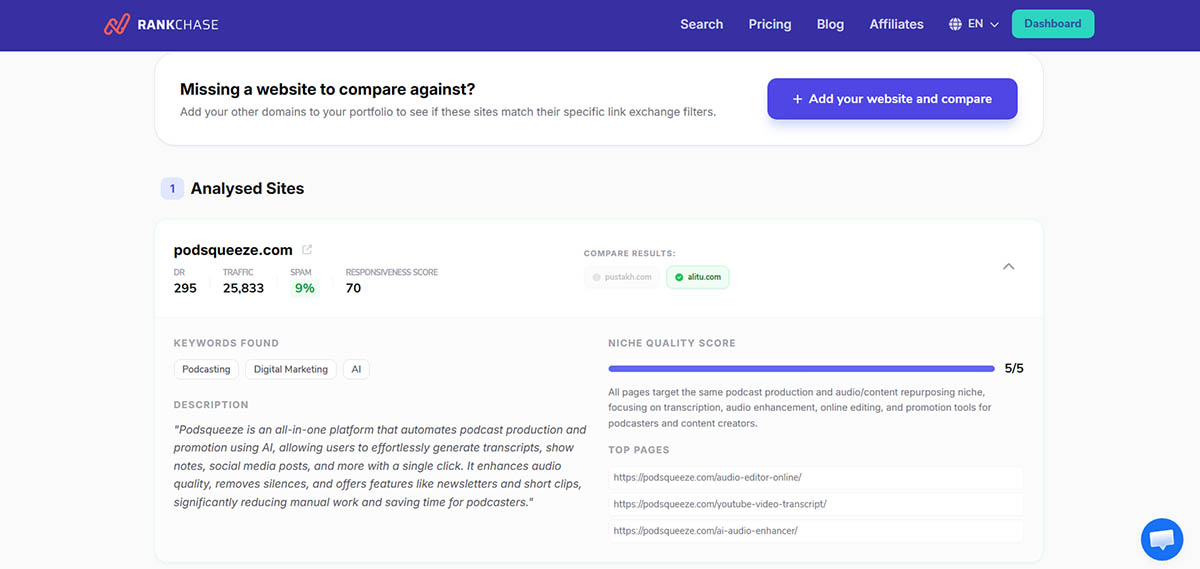
When I vet this manually, I check the last 20 to 30 indexed articles and look for pattern alignment:
- Are they targeting similar SERP themes?
- Are they writing for the same buyer stage?
- Would I feel comfortable citing them in my own article?
If yes, that is a workable partner.
Consistent Organic Traffic Over Vanity Metrics (DA/DR)
A decent DR with weak organic visibility is one of the most common traps in link exchange. Finding quality link partners with real traffic is essential for a healthy profile.
I would take a lower-authority site with steady, relevant organic traffic over a flashy DR site with no ranking footprint almost every time.
Why? Because traffic tells you the site is still alive in search. It suggests pages are getting indexed, crawled, and trusted enough to surface. It also helps you avoid domains that inflated authority through old links, redirects, or pure link selling.
This is where backlink tools are useful, but only if you read them correctly. Tools like Ahrefs’ Link Intersect are built to show sites linking to competitors but not to you, and Semrush’s Backlink Gap is designed to surface missing referring domains and prioritize opportunities from overlap analysis.
When reviewing a prospect, I look for:
- traffic trend stability over the last 6 to 12 months
- rankings in topics related to the page where my link would go
- a reasonable share of traffic going to editorial pages, not just one viral outlier
- indexed content being added consistently
If the graph has fallen off a cliff, pause. If almost all their traffic comes from one irrelevant page, pause. If the site publishes constantly but nothing ranks, pause.
Traffic quality beats authority optics.
A practical threshold many people miss: the referring page matters more than the homepage metric. A DR 35 site with a relevant article ranking for solid mid-funnel terms can beat a DR 70 site whose article never gets impressions.
A Clean and Natural Outbound Link Profile
This is the filter that saves you from most garbage opportunities.
Open three or four recent articles and inspect the outbound links. You are looking for pattern, not perfection.
Good signs:
- links point to relevant sources, tools, companies, and references
- anchors sound natural
- external links support the article instead of hijacking it
- there is editorial restraint
Bad signs:
- every post contains multiple exact-match commercial anchors
- links point to unrelated industries
- every article looks like it was built to host placements
- author bios, footers, or “partner” pages carry obvious cross-link footprints
Here is a simple vetting table I use.
If a site fails two red-flag checks, I usually drop it.
If you want to speed this up, a tool like Rankchase can help narrow the pool by surfacing sites based on niche relevance, traffic patterns, authority, and spam indicators. That does not replace manual review, but it cuts out a lot of obvious mismatch.
Proven Methods to Discover Relevant Link Exchange Opportunities
Once you know what a good partner looks like, the next step is building a prospect pipeline that is actually worth contacting.
This is where most teams either get efficient or waste a month.
Utilize Advanced Google Search Operators
Search operators still work well for finding pages that are open to collaboration, guest contributions, resource mentions, or editorial partnerships. The mistake is using them too broadly.
You are not searching for “write for us” and emailing 500 sites.
You are searching for context-rich opportunities inside your niche.
Try combinations like these:
"your niche" intitle:"write for us"
"your niche" inurl:guest-post
"your niche" "contribute"
"your niche" "resources"
"your niche" "recommended tools"
"your niche" "partners"
"keyword" "submit an article"
Then tighten the query based on the content type you want.
If you want contextual insertions, search for pages that already discuss your target subtopic:
"invoice automation" "small business"
"technical seo audit" "site migration"
"email deliverability" "spf dkim dmarc"
From there, ask a better question: Does this page have a real reason to link to my asset?
That one question prevents lazy prospecting.
A mini-workflow:
- Search the subtopic.
- Open pages ranking or indexed around that topic.
- Check whether your article, tool, data point, or guide would improve the page.
- Save only the pages where the answer is clearly yes.
This is slower than mass scraping, but your reply rate and placement quality will be better.
Run Competitor Backlink Intersects to Find Link Overlaps
This is one of the fastest ways to find sites already comfortable linking within your niche.
Both Ahrefs and Semrush support this workflow. Ahrefs’ Link Intersect lets you compare your domain against up to multiple competitor domains and see referring domains or pages that link to them but not to you. Semrush’s Backlink Gap is built around the same idea of missing referring domains across competitors.
Here is the practical version.
Pick 3 to 5 competitors who are close to you in topic, not just in business model. Then run the intersect.
Now do not blindly contact every domain in the export. Segment them.
Bucket A: editorial fit These are blogs, SaaS companies, associations, or publishers that regularly link to useful resources in your niche.
Bucket B: list-based fit These are roundup pages, “best tools” pages, resource centers, and comparison articles.
Bucket C: low-value clutter Directories, scraper sites, syndication domains, language variants, and obvious paid-post farms.
You only want A and selected B.
Then go one layer deeper and inspect the exact linking page. This matters because a referring domain may look good overall while the actual linking page is low quality.
A good shortcut is to filter for domains linking to two or more competitors. That usually surfaces sites already active in your ecosystem. But still apply your manual review. Overlap is a clue, not approval.
Leverage Vetted SEO Networking Communities
Some of the best exchange opportunities never show up in public search because they come through relationship networks.
Not “drop your site below” groups. Real communities where people discuss placements, collaborations, content gaps, and quality standards.
The trick is to use communities as a filtering layer, not as proof that someone is safe to work with.
When I look at community-based opportunities, I still check:
- whether the site is topically close
- whether the team actually understands editorial placement
- whether they are selective, not desperate
- whether their existing links look natural
A lot of experienced link builders quietly avoid blasting opportunities publicly because the moment a domain gets overused, the quality drops. That is why private or semi-vetted spaces can be useful. You often get better partners and fewer junk offers.
Still, be careful with speed. If someone offers 20 instant swaps across unrelated domains, that is not a partnership. That is inventory.
Identify Non-Competing Businesses in Your Industry
This is one of the most underused methods because it does not feel like “SEO outreach,” but it works.
Look for businesses that serve the same audience from a different angle.
Examples:
- an email marketing platform and a CRM consultant
- a wedding photographer and a wedding planner
- a bookkeeping service and a payroll software company
- a physical therapist and a sports massage clinic
- a cybersecurity consultancy and a compliance software vendor
These are often the cleanest partnerships because the relevance is real, but the competitive tension is low.
The best opportunities usually come from content assets, not homepage swaps.
Think:
- guides that complement each other
- resource pages
- local recommendation pages
- co-created content
- industry glossary pages
- case studies with overlapping stakeholders
Short checklist for this method:
- Same audience?
- Different core service?
- Clear content overlap?
- Natural reason to reference each other?
- Good site quality?
If all five are yes, that is a high-priority prospect.
Best Practices for Outreach and Relationship Building
Finding prospects is only half the job. Bad outreach can ruin good opportunities fast.
This part is where a lot of campaigns fall apart, especially when the sender clearly treats the link as a transaction and the site owner can smell it in one line.
Why Cold Spam Fails for Quality Link Swaps
Quality site owners ignore templated outreach because they have seen it all before.
The usual message says something vague about “collaboration,” praises the site with a fake compliment, then immediately asks for a swap. That approach fails because it does not show editorial understanding, and it gives the recipient extra work to figure out whether the suggestion is legitimate.
Cold spam also attracts the wrong partners. The people who respond fastest to mass outreach are often the ones monetizing every available paragraph.
If your outreach process rewards volume over fit, your prospect pool will get worse over time.
A better mindset is this: you are proposing a content improvement, not requesting a favor.
That subtle shift changes everything. It forces you to identify the page, the angle, the missing value, and the reason your content belongs there.
Crafting a Highly Personalized Pitch
Personalization does not mean writing a novel.
It means proving three things quickly:
- You reviewed their site.
- You have a specific placement idea.
- Your suggestion makes the page better.
A simple structure works well:
- mention the exact page
- mention the topic gap or context
- suggest your asset
- explain why it helps their readers
- keep the ask clean and low-friction
Example:
Hi [Name], I was reading your guide on contractor invoicing and noticed the section on reducing late payments. We recently published a practical template-driven piece on invoice follow-up workflows for service businesses. It could fit naturally in that section because it expands on what happens after the invoice is sent, especially for field teams. If helpful, I can send the exact paragraph where it might slot in.
That works better than “Would you like to exchange backlinks?”
Why? Because it sounds like someone who has actually read the article.
If a reciprocal opportunity exists, let it emerge naturally after a real conversation starts. In many cases, the cleanest path is not asking for a direct swap in line one. It is identifying mutual relevance first.
Leading with Value and Mutual Benefit
The best outreach gives before it asks.
That value can be small:
- pointing out a broken resource
- suggesting a better supporting article
- offering original data or a quote
- proposing a co-created piece
- mentioning a page where you can already reference them appropriately
This is where experienced practitioners get better results than beginners. They know that site owners do not care about your spreadsheet. They care about whether your suggestion saves them time, improves their page, or helps their audience.
A practical rule I use:
- If the only benefit is “we both get a link,” the pitch is weak.
- If the benefit is “your article becomes more useful and we can support each other editorially,” the pitch is stronger.
Sometimes a direct reciprocal link is fine. Sometimes the better play is one site adds a link now, and the other side later contributes via guest content, a brand mention, a quote, or a future resource page. That flexibility keeps the relationship natural.
How to Execute Backlink Exchanges the Right Way (Without Penalties)
This is where nuance matters.
There is a huge difference between a few carefully chosen, editorially sensible exchanges and a scaled pattern of negotiated links across weak pages.
Google explicitly lists excessive link exchanges as link spam, and also flags guest posts or advertorial-style placements when links pass ranking credit in manipulative ways. At the same time, Google’s documentation on outbound links explains how paid or sponsored arrangements should be qualified with rel="sponsored" or rel="nofollow" where appropriate.
So your execution standard should be simple: make the link make sense first, then make the footprint small.
Direct Reciprocal Swaps vs. 3-Way (ABC) Link Exchanges
Direct reciprocal swaps are the most obvious format.
Site A links to Site B. Site B links to Site A.
These can happen naturally, especially in small industries, but they become risky when they are frequent, forced, and built primarily for ranking manipulation.
3-way exchanges try to reduce that footprint:
- Site A links to Site B
- Site B links to Site C
- Site C links to Site A
This can look cleaner on paper, but it is not automatically safer just because the pattern is less visible. If the sites are weak, irrelevant, or clearly part of a coordinated exchange circle, the structure does not save it.
My decision rule:
- Use direct swaps only when the topical relationship is obvious and each link stands on its own editorially.
- Avoid building repeated reciprocal patterns between the same two domains.
- Do not use ABC structures as a way to justify bad placements.
In practice, if you need to explain the architecture more than the content, the tactic is doing too much heavy lifting.
Choosing Between Guest Posts and Contextual Niche Edits
Both formats can work, but they solve different problems.
Guest posts are better when:
- you need fresh context
- you can contribute something genuinely useful
- the host site maintains quality standards
- the article fits their editorial style and audience
Contextual niche edits are better when:
- the host already has a strong page on the topic
- your resource clearly improves an existing section
- the page is indexed, ranking, and still maintained
- the insertion feels obvious, not wedged in
A lot of people overuse guest posts because they are easier to negotiate. But if the post is thin, generic, or created mainly to host a link, it can turn into the exact kind of low-value content Google warns about in spam policy examples.
I prefer contextual edits when the fit is strong because they place your link inside an existing page with history, relevance, and often better performance. But only if the page is actually good.
Here is the quick test:
- If the existing article already answers the right query and your asset adds depth, go with a niche edit.
- If the topic gap is real and you can publish something genuinely useful to their audience, go with a guest post.
In both cases, avoid over-optimized anchors. Write the anchor the way an editor would naturally reference the page.
Maintaining a Natural Link Velocity
A handful of relevant placements over time looks normal. A sudden burst of similar exchanges across the same period does not.
This is one of those things practitioners notice after enough cleanup work. The issue is rarely one link. It is the pattern.
Natural velocity means:
- link acquisition is spread over time
- sources are varied
- anchors are mixed
- link types are mixed
- not every new link has a reciprocal counterpart
This is why I usually recommend treating exchanges as one lane inside a broader acquisition mix that also includes digital PR, unlinked mentions, resource inclusion, citations, guest contributions, and naturally earned links.
If you build 30 “partnership” links in six weeks and 24 of them come from similar articles with mirrored anchors, that is a footprint.
If you build 6 highly relevant partnerships over several months, mixed with other acquisition sources, that is a much healthier profile.
A good working cap for most sites is not a universal number. It is a ratio question: Would these exchanges still look normal if someone reviewed your last 50 new links manually?
If the answer is no, slow down.
Frequently Asked Questions About Relevant Link Swapping
How many niche-relevant backlinks do I actually need?
Enough to close the authority and trust gap in your SERP segment, but not so many that you start chasing volume over quality.
Here is the practical way to think about it.
If the page you want to rank is competing with sites that each have 20 strong referring domains to that URL or topic cluster, you probably do not need 200 random links. You need a smaller number of better-aligned links to the right page types.
For a newer site, even 5 to 15 highly relevant links to strong commercial or informational pages can move the needle more than dozens of weak placements. For more competitive SERPs, you may need a sustained campaign, but the same rule holds: relevance first, volume second.
I usually assess need using three layers:
-
Page-level gap
Compare the target page’s referring domains to the pages currently ranking. -
Domain-level trust gap
Are you broadly trusted in the topic, or trying to rank one page on an otherwise weak site? -
Topical cluster support
Do supporting articles in the same cluster also attract links, or is all the pressure on one URL?
If you are an intermediate SEO, this is the useful answer: stop asking for a magic number and start asking which 10 sites would actually strengthen this topic cluster.
That question leads to better campaigns.
Will Google penalize me for trading links?
Not automatically for a small number of relevant, editorially sensible cross-links.
But Google does call out excessive link exchanges and partner pages created just for cross-linking as link spam, and it also warns against manipulative guest posting and other link patterns intended primarily to pass ranking credit. Google’s guidance on outbound links also says paid or sponsored links should be qualified appropriately.
So the safer answer is this:
You are far less likely to create problems when the links are:
- topically relevant
- useful to readers
- placed in strong editorial context
- moderate in volume
- not built with obvious reciprocal footprints
- not using aggressive commercial anchors
- not part of a scaled swapping system
You increase risk when the links are:
- exchanged in bulk
- placed on unrelated sites
- added to low-quality pages
- repeated with mirrored anchors
- tied to payment or compensation without proper qualification
- clustered in obvious partner networks
The line is not “all exchanges are banned.” The line is whether the pattern looks like real editorial linking or a system designed to manipulate rankings.
If you keep that distinction front and center, you will make better decisions on every prospect, every email, and every placement.